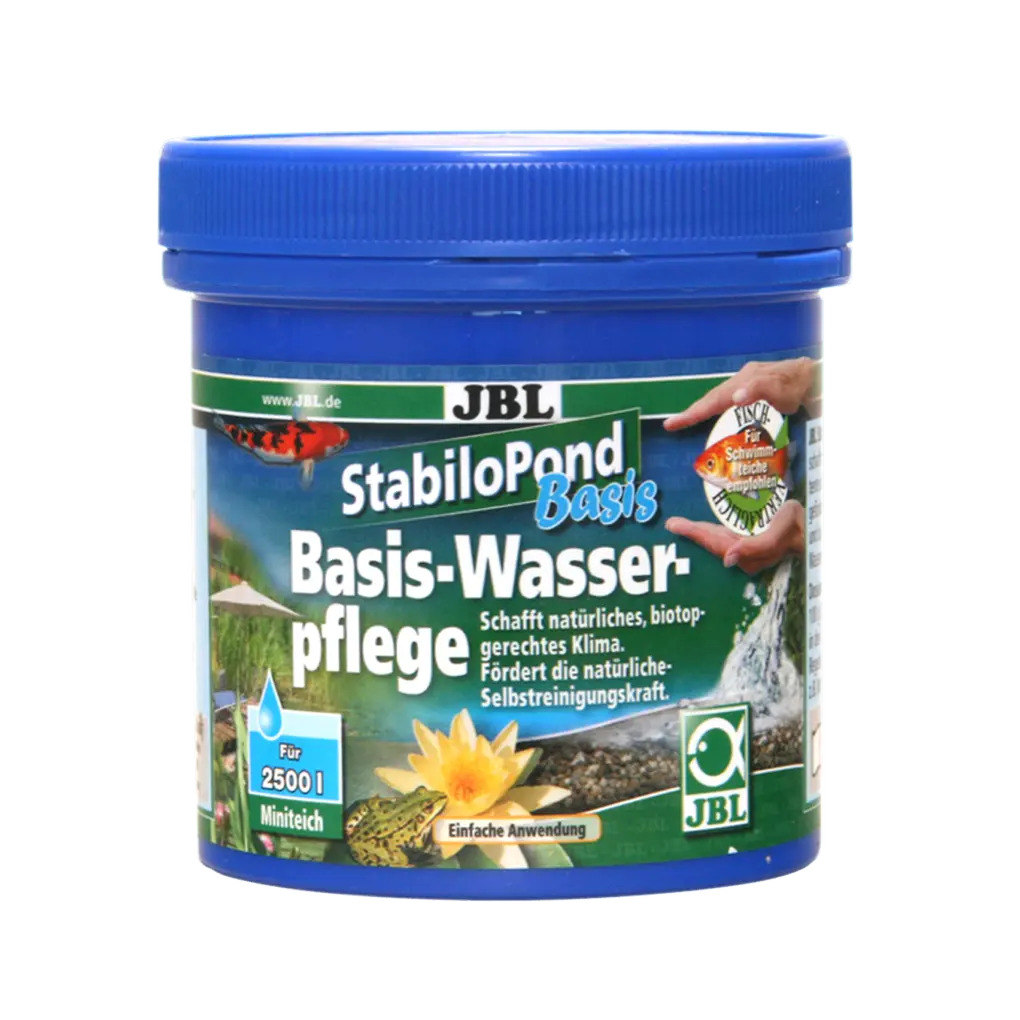
JBL StabiloPond Basis 250g
Archived
Item no. 2731000
Product no longer available
Shop locator
In unserem FAQ‑Bereich findet ihr Antworten auf die am häufigsten gestellten Fragen. Solltet ihr hier nicht fündig werden, zögert bitte nicht, uns direkt zu kontaktieren – wir helfen euch gerne weiter.
JBL StabiloPond Basis raises both the total hardness and the carbonate hardness. JBL StabiloPond KH raises the total hardness to the carbonate hardness at a ratio of 1:2.
The dosage required depends on several factors: _x000D_ _x000D_ 1) The present carbonate hardness _x000D_ _x000D_ For a carbonate hardness of 0-2 °dKH you need 200g / 1000 l pond water. _x000D_ _x000D_ For a carbonate hardness of 2-4 °dKH you need 100g / 1000 l pond water. _x000D_ _x000D_ 2) Processes in the garden pond which affect the carbonate hardness _x000D_ _x000D_ Algal bloom (floating or filamentous algae) and an insufficient stabilisation of the water balance may make a higher or additional dosage necessary, because the algae will start the biogenic decalcification very soon after the addition of JBL StabiloPond Basis. _x000D_ _x000D_ Furthermore strong sediment production will cause microorganisms to decompose the components of JBL StabiloPond Basis at the bottom of the pond. In this case a higher or additional dosage can likewise be necessary.
JBL StabiloPond Basis and JBL StabiloPond KH are salt mixtures, which stabilise (raise) the general hardness and the carbonate hardness. Nutrients for algae are not included, yet the algae may appear to grow faster after the addition of JBL StabiloPond. _x000D_ _x000D_ This is because most pond water doesn’t have enough minerals for the organisms living in it. When the missing minerals are added to improve the mineral supply for all the organisms, it impacts the algae too. Nutrients for algae are almost always present in the water. _x000D_ _x000D_ Some algae species can store up to 100,000 times their own phosphate requirements.
How JBL StabiloPond Basis is used: _x000D_ _x000D_ Regular applications every 2 months (central European conditions with 500 – 1000 mm rainfall per year). _x000D_ _x000D_ For first application or with carbonate hardness 0 a dosage of 200g / 1.000 l pond water is used. For follow-up treatments 100g / 1000 l pond water is sufficient. _x000D_ _x000D_ The powder is sprinkled onto the pond. Do not dissolve it in water beforehand, this will cause it to foam, which reduces the stabilizing effect for the pond water.
As a result of a variety of processes the water in the garden pond is permanently losing minerals and hydrogen carbonate, the latter of which acts as a buffer for the pH value. These processes are: _x000D_ _x000D_ Rainfall: Rainfall is softened pure water and dilutes the pond water. The total hardness and the carbonate hardness decrease._x000D_ _x000D_ Biogenic decalcification: When there is a lack of carbon dioxide in the water, some plants and algae in particular meet their demand for CO2 through biogenic decalcification: _x000D_ _x000D_ Ca(HCO3)2 (only dissolved) <-> CaCO3 (precipitates as lime) + H2O + CO2. _x000D_ _x000D_ Lime precipitates as a by-product and both the carbonate hardness and the total hardness decrease. _x000D_ _x000D_ Nitrification in the filter: Through the nitrification caused by filter bacteria nitrite develops. Nitrite is the salt ion of the nitrous acid. The acid ion (H+) also is precipitated and reacts with the hydrogen carbonate in the water: _x000D_ _x000D_ H+ (acid cation) + HCO3- (hydrogen carbonate) <-> H2O + CO2. _x000D_ _x000D_ Thus the nitrification uses up hydrogen carbonate and the carbonate hardness decreases. Mineral consumption through plants and animals: All organisms need minerals for their metabolism and their growth, including calcium, magnesium and others. Thus plants, bacteria, algae, insects, snails, mussels and other invertebrates such as fish all cause the total hardness in the garden pond to decrease. _x000D_ _x000D_ JBL StabiloPond Basis evenly portions the minerals needed in the garden pond (including calcium and magnesium) and does more than just raise the carbonate hardness. _x000D_ _x000D_ Additional regular post-dosing, individually adjusted, may be necessary, depending on the rainfall, which varies from year to year and from region to region. In Central Europe a regular dose on a 2 monthly basis is sufficient. With higher rainfall an additional dosage on a 4-6 weekly basis can be necessary. To find out, use JBL PondCheck.
StabiloPond Basis and KH raise the hardness, always and without exception. If the hardness hasn’t increased measurably there are only 3 possible reasons: _x000D_ _x000D_ - The pond has no filtering or circulation. Then a layering of the water occurs. The hardened water is located near the bottom of the pond. _x000D_ - The products were under-dosed_x000D_ - An increase in hardness occurred, but the values dropped afterwards quickly. _x000D_ _x000D_ The latter is mainly possible with high sludge quantities or with an algae plague. It is as if microbes and algae (have to) exist on the back burner when there isn’t enough stabilised water. Just like other organisms in the pond they suffer from a lack of essential minerals, like calcium, magnesium and especially hydrogencarbonates. Metaphorically speaking, they pounce upon the dissolving salts in StabiloPond Basis and KH and immediately start to assimilate them. These effects can occur in ponds with strong organic loads (sludge) and excessive algae blooms. In the latter case an algae treatment is absolutely necessary._x000D_
Each JBL anti-algae agent has a special purpose. It is therefore not necessary to use several AlgoPond products at the same time. Use AlgoPond Green to combat green water. Use AlgoPond forte for thread algae and all other types of algae. If you want to change the product, allow a time interval of 14 days, a water change of at least 50 % and filtering via activated carbon. The products StabiloPond and PhosEx may, of course, be used together with an AlgoPond algae agent according to the 1-2-3 algae-free principle.
Stelle deine Frage an das JBL Service Team.