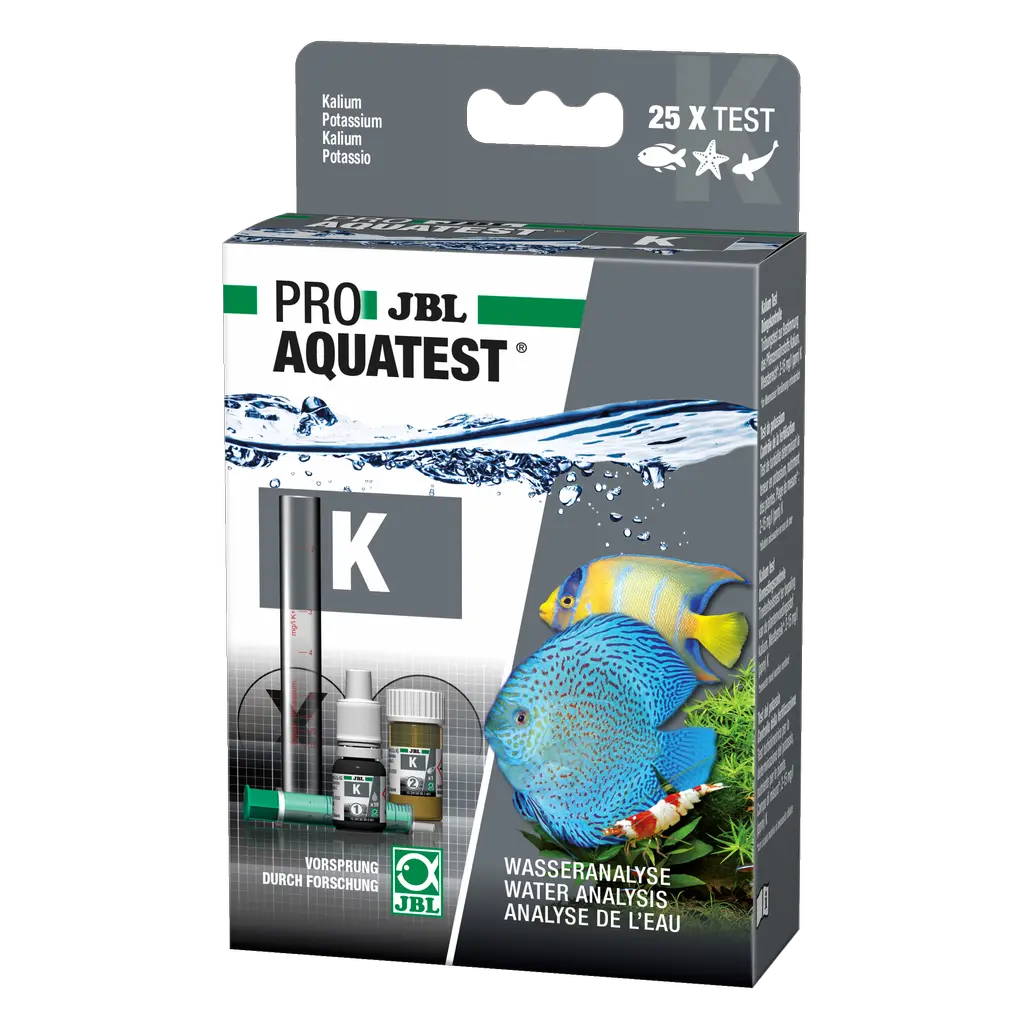
JBL PROAQUATEST K Kalium

Voor een perfecte groei van aquariumplanten: bepaling van de optimale kaliumwaarde voor bemestingscontrole voor zoetwateraquaria

28.8 EUR

Preis inkl. 21 MwSt zzgl. Versand
De voorraad is onderweg
Händlersuche Gefahrenhinweise

Produktmerkmale

  • Voor een perfecte plantengroei: Bepaling van de optimale kaliumwaarde ten behoeve van de mestcontrole in zoetwateraquaria
  • Sneltest: Cuvet met testwater vullen, reagentia toevoegen, troebel testwater in de speciale glazen cuvet gieten tot het daaronder liggende kruis niet meer zichtbaar is, gevulde hoeveelheid aflezen. Deze waarde vormt het kaliumgehalte in mg/l
  • Vaak leidt een te gering kaliumgehalte tot een stagnerende plantengroei hoewel alle andere factoren, zoals CO2, ijzer en licht, beschikbaar zijn. Met meststoffen, zoals JBL Ferropol en JBL ProScape K macroelements, kunt u het kaliumgehalte verhogen
  • Op de JBL homepage in de themawereld Aquarium vindt u uitgebreide informatie met betrekking tot wateranalyses en probleemoplossingen
  • Inhoud: 1 Kalium testset voor ca. 25 metingen incl. reagentia, speciale glazen cuvet, spuit, doseerlepel en kleurenkaart. Navullende reagens afzonderlijk verkrijgbaar

Gefahrenhinweise

JBL K 1 - Sicherheitsinformationen gemäß GHS

Signalwort: Gevaar

Gefahrensymbol

corrosive

Gefahrenhinweis

  • H318: Veroorzaakt ernstig oogletsel.
  • H314: Veroorzaakt ernstige brandwonden en oogletsel.

Sicherheitshinweise

  • P101: Bij het inwinnen van medisch advies, de verpakking of het etiket ter beschikking houden.
  • P102: Buiten het bereik van kinderen houden.

Gefahrbestimmende Komponente

  • 1310-73-2: natriumhydroxide

JBL K 2 - Sicherheitsinformationen gemäß GHS

Signalwort: Gevaar

Gefahrensymbol

corrosive

Gefahrenhinweis

  • H318: Veroorzaakt ernstig oogletsel.
  • H314: Veroorzaakt ernstige brandwonden en oogletsel.

Sicherheitshinweise

  • P101: Bij het inwinnen van medisch advies, de verpakking of het etiket ter beschikking houden.
  • P102: Buiten het bereik van kinderen houden.

Information and consent to cookies & third-party content

We use technically necessary cookies/tools to offer, operate and secure this service. Furthermore ,with your express consent , we use cookies/tools for marketing, tracking, creating personalised content on third-party sites and for displaying third-party content on our website. You can revoke your consent at any time with effect for the future via the menu item ‘Cookie settings’.
By clicking on ‘Allow all’, you give us your express consent to the use of cookies/tools to improve the quality and performance of our service, for functional and personalised performance optimisation, to measure the effectiveness of our ads or campaigns, for personalised content for marketing purposes, including outside our website. This enables us to provide personalised online ads and extended analysis options about your user behaviour. This also includes accessing and storing data on your device. You can revoke your consent at any time with effect for the future via the menu item ‘Cookie settings’.
You can use the ‘Change settings’ button to grant and revoke individual consent to the cookies/tools and receive further information on the cookies/tools we use, their purposes and duration.
By clicking on ‘Only absolutely necessary’, only technically necessary cookies/tools are used.

Our data protection declaration tells you how we process personal data and what purposes we use the data processing for.
PUSH messages from JBL

What are PUSH messages? As part of the W3C standard, web notifications define an API for end-user notifications that are sent to the user's desktop and/or mobile devices via the browser. Notifications appear on the end devices as they are familiar to the end user from apps installed on the device (e.g. emails). Notifications appear on the end user’s device, just like an app (e.g. for emails) installed on the device.

A notification makes it possible to inform the user about an event outside the context of a website, such as a new blog post, a competition or a voucher.

These notifications enable a website operator to contact its users whenever they have a browser open - it doesn’t matter whether the user is currently visiting the website or not.

To be able to send web push notifications, all you need is a website with a web push code installed. This allows brands without apps to take advantage of many of the benefits of push notifications (personalised real-time communications at just the right moment).

Web notifications are part of the W3C standard and define an API for end user notifications. A notification makes it possible to inform the user about an event, such as a new blog post, outside the context of a website.

JBL GmbH & Co. KG provides this service free of charge, and it is easy to activate or deactivate.