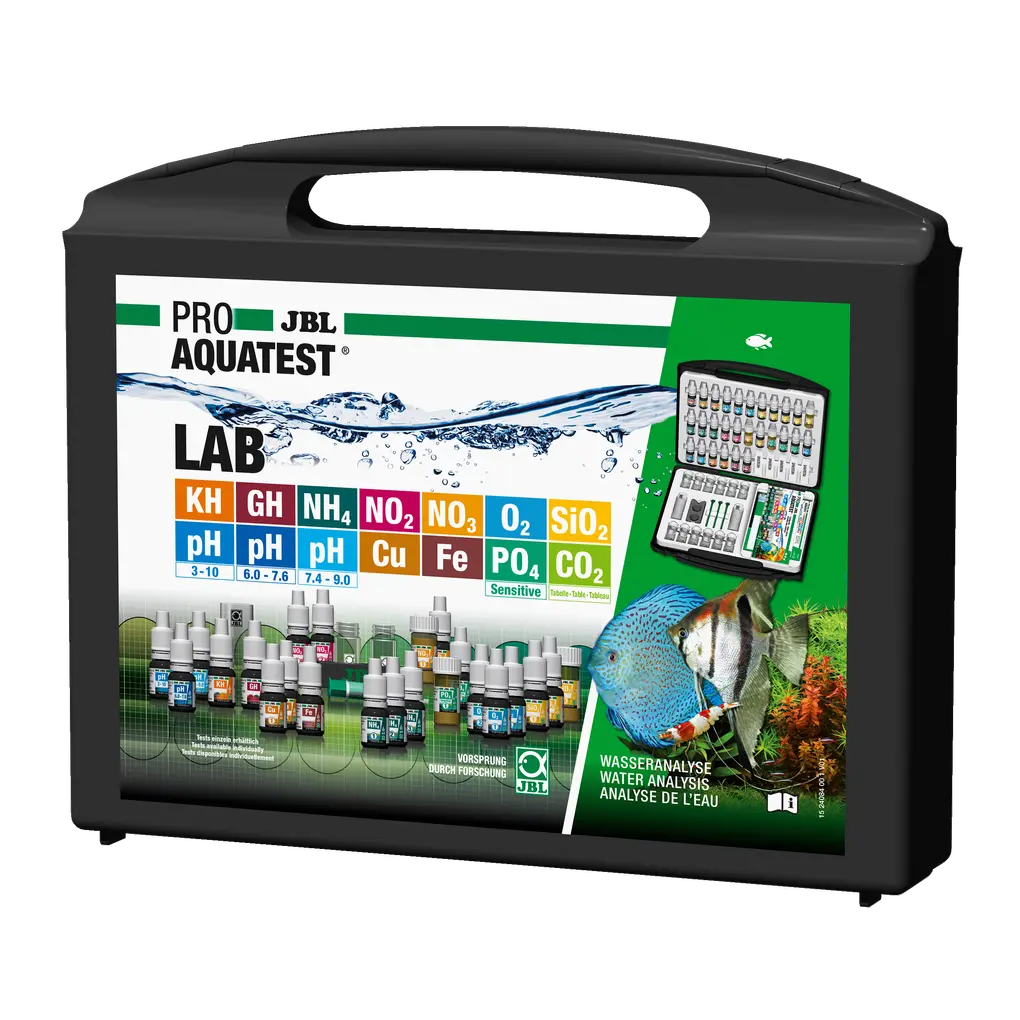
JBL PROAQUATEST LAB

Simple and reliable monitoring of aquarium water values. Determination of: pH value (3 ranges), carbonate hardness, total hardness, ammonium/ammonia, nitrite, nitrate, phosphate, iron, copper, silicate, oxygen and CO2 Calculation using table
Item no. 2408417

100.03 GBP

Price incl. 20 VAT plus Delivery
Shop locator Hazard statements

Product features

  • Monitors water values in aquariums simply and reliably. Determines pH (3 ranges), carbonate hardness, general hardness, ammonium/ammonia, nitrite, nitrate, phosphate, iron, copper, silicate, oxygen, and, with the help of a table, the CO2 calculation
  • Add the reagents to the water samples, compare on the colour chart, read off the values and check the analysis sheet to see which actions are recommended, if any
  • Comparator system takes the inherent water colouring into account. CO2-content is determined by pH value and KH value using the table
  • Contains a childproof reagent bottle in a waterproof plastic case. Refill reagents are separately available
  • Package contents: 1 test case, incl. 13 tests, 12 glass vials, 2 syringes, 3 measuring spoons, thermometer, comparator block, 2 plastic cuvettes, colour charts, CO2 table, pen, report sheets, operating instructions

Hazard statements

JBL pH 3-10 - Safety information according to GHS

Signal word: Attention

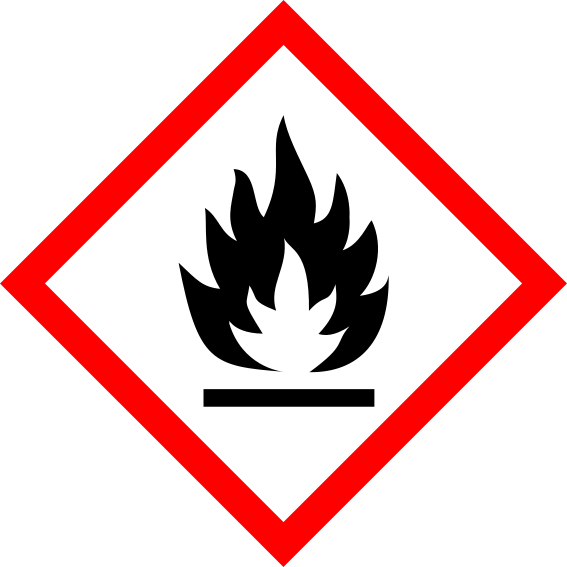
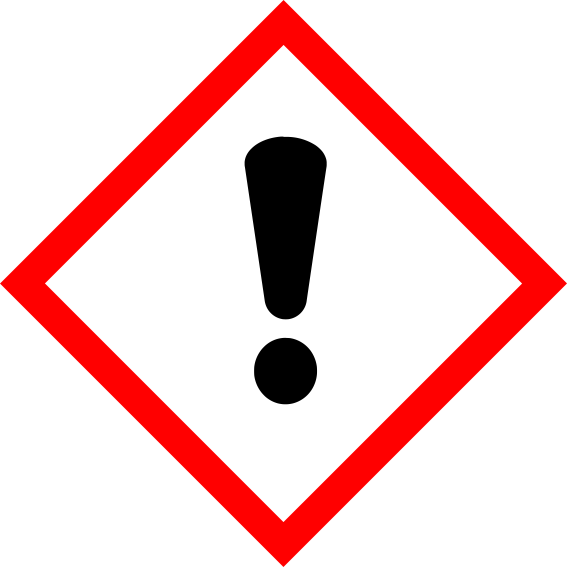
Hazard symbol

flammable irritant

Hazard statement

  • H319: Causes serious eye irritation.
  • H226: Flammable liquid and vapour.

Safety instructions

  • P101: If medical advice is needed, have product container or label at hand.
  • P102: Keep out of reach of children.

JBL NO3 2 - Safety information according to GHS

Signal word: Danger

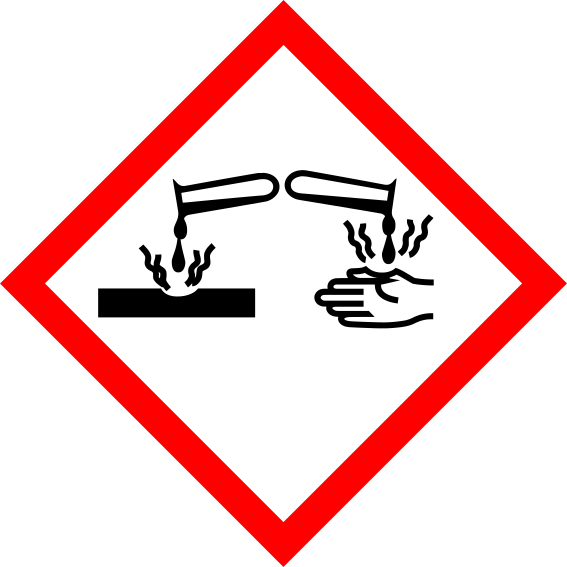
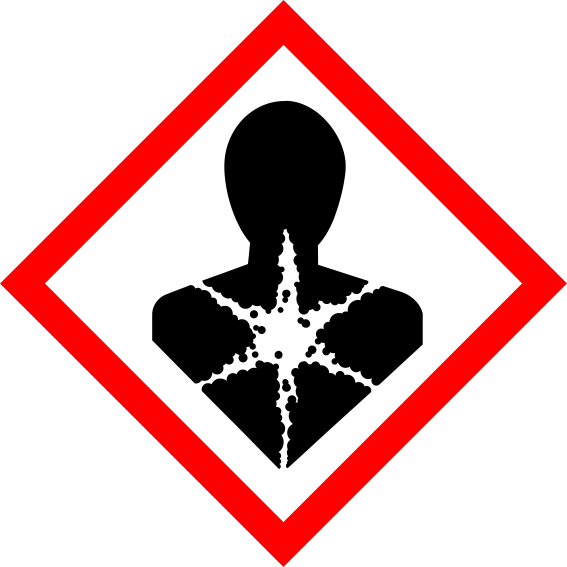
Hazard symbol

corrosive irritant health_hazard

Hazard statement

  • H318: Causes serious eye damage.
  • H314: Causes severe skin burns and eye damage.
  • H341: Suspected of causing genetic defects.
  • H317: May cause an allergic skin reaction.
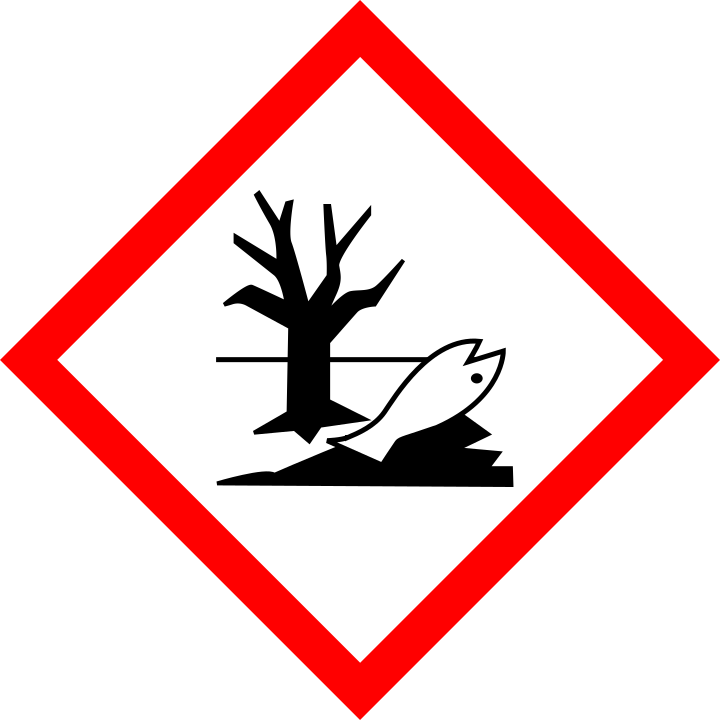
  • H412: Harmful to aquatic life with long lasting effects.

Safety instructions

  • P101: If medical advice is needed, have product container or label at hand.
  • P102: Keep out of reach of children.

Hazardous component

  • 7647-01-0/1: hydrogen chloride
  • 541-69-5: m-phenylenediamine dihydrochloride

JBL NO3 1 - Safety information according to GHS

Signal word: Danger

Hazard symbol

corrosive irritant environmental_hazard

Hazard statement

  • H318: Causes serious eye damage.
  • H314: Causes severe skin burns and eye damage.
  • H317: May cause an allergic skin reaction.
  • H411: Toxic to aquatic life with long lasting effects.

Safety instructions

  • P101: If medical advice is needed, have product container or label at hand.
  • P102: Keep out of reach of children.

Hazardous component

  • 87-69-4: (+)-tartaric acid
  • 121-57-3: sulphanilic acid

JBL PO4 Sensitive 2 - Safety information according to GHS

Signal word: Danger

Hazard symbol

corrosive irritant

Hazard statement

  • H318: Causes serious eye damage.
  • H314: Causes severe skin burns and eye damage.
  • H302: Harmful if swallowed.
  • H335: May cause respiratory irritation.

Safety instructions

  • P101: If medical advice is needed, have product container or label at hand.
  • P102: Keep out of reach of children.

Hazardous component

  • 7647-01-0/1: hydrogen chloride

JBL NO2 2 - Safety information according to GHS

Signal word: Attention

Hazard symbol

flammable irritant

Hazard statement

  • H319: Causes serious eye irritation.
  • H226: Flammable liquid and vapour.

Safety instructions

  • P101: If medical advice is needed, have product container or label at hand.
  • P102: Keep out of reach of children.

JBL NO2 1 - Safety information according to GHS

Signal word: Danger

Hazard symbol

corrosive

Hazard statement

  • H318: Causes serious eye damage.
  • H314: Causes severe skin burns and eye damage.

Safety instructions

  • P101: If medical advice is needed, have product container or label at hand.
  • P102: Keep out of reach of children.

Hazardous component

  • 64-19-7: Acetic acid

JBL pH 6.0-7.6 - Safety information according to GHS

Signal word: Attention

Hazard symbol

flammable irritant

Hazard statement

  • H319: Causes serious eye irritation.
  • H226: Flammable liquid and vapour.

Safety instructions

  • P101: If medical advice is needed, have product container or label at hand.
  • P102: Keep out of reach of children.

JBL pH 7.4-9.0 - Safety information according to GHS

Signal word: Attention

Hazard symbol

flammable irritant

Hazard statement

  • H319: Causes serious eye irritation.
  • H226: Flammable liquid and vapour.

Safety instructions

  • P101: If medical advice is needed, have product container or label at hand.
  • P102: Keep out of reach of children.

JBL GH - Safety information according to GHS

Signal word: Attention

Hazard symbol

flammable irritant

Hazard statement

  • H319: Causes serious eye irritation.
  • H226: Flammable liquid and vapour.
  • H315: Causes skin irritation.

Safety instructions

  • P101: If medical advice is needed, have product container or label at hand.
  • P102: Keep out of reach of children.

JBL KH - Safety information according to GHS

Signal word: Danger

Hazard symbol

flammable corrosive

Hazard statement

  • H226: Flammable liquid and vapour.
  • H318: Causes serious eye damage.
  • H314: Causes severe skin burns and eye damage.

Safety instructions

  • P101: If medical advice is needed, have product container or label at hand.
  • P102: Keep out of reach of children.

JBL O2 1 - Safety information according to GHS

Signal word: Danger

Hazard symbol

corrosive health_hazard

Hazard statement

  • H318: Causes serious eye damage.
  • H314: Causes severe skin burns and eye damage.
  • H373: May cause damage to organs through prolonged or repeated exposure.
  • H412: Harmful to aquatic life with long lasting effects.

Safety instructions

  • P101: If medical advice is needed, have product container or label at hand.
  • P102: Keep out of reach of children.

Hazardous component

  • 7773-01-5/1: manganese dichloride

JBL O2 2 - Safety information according to GHS

Signal word: Danger

Hazard symbol

corrosive

Hazard statement

  • H318: Causes serious eye damage.
  • H314: Causes severe skin burns and eye damage.

Safety instructions

  • P101: If medical advice is needed, have product container or label at hand.
  • P102: Keep out of reach of children.

Hazardous component

  • 1310-73-2: sodium hydroxide

JBL O2 3 - Safety information according to GHS

Signal word: Danger

Hazard symbol

corrosive health_hazard

Hazard statement

  • H318: Causes serious eye damage.
  • H314: Causes severe skin burns and eye damage.
  • H317: May cause an allergic skin reaction.
  • H334: May cause allergy or asthma symptoms or breathing difficulties if inhaled.

Safety instructions

  • P101: If medical advice is needed, have product container or label at hand.
  • P102: Keep out of reach of children.

Hazardous component

  • 7664-93-9: sulphuric acid
  • 137-09-7/2: 4-hydroxy-m-phenylenediammonium dichloride

JBL Cu 2 - Safety information according to GHS

Signal word: Attention

Hazard symbol

flammable irritant

Hazard statement

  • H319: Causes serious eye irritation.
  • H226: Flammable liquid and vapour.

Safety instructions

  • P101: If medical advice is needed, have product container or label at hand.
  • P102: Keep out of reach of children.

JBL Fe - Safety information according to GHS

Signal word: Attention

Hazard symbol

irritant

Hazard statement

  • H319: Causes serious eye irritation.
  • H302: Harmful if swallowed.
  • H317: May cause an allergic skin reaction.

Safety instructions

  • P101: If medical advice is needed, have product container or label at hand.
  • P102: Keep out of reach of children.

Hazardous component

  • 5421-46-5: ammonium mercaptoacetate

JBL SiO2 1 - Safety information according to GHS

Signal word: Danger

Hazard symbol

corrosive

Hazard statement

  • H318: Causes serious eye damage.
  • H314: Causes severe skin burns and eye damage.

Safety instructions

  • P101: If medical advice is needed, have product container or label at hand.
  • P102: Keep out of reach of children.

Hazardous component

  • 7664-93-9: sulphuric acid

JBL SiO2 2 - Safety information according to GHS

Signal word: Danger

Hazard symbol

corrosive

Hazard statement

  • H318: Causes serious eye damage.
  • H314: Causes severe skin burns and eye damage.

Safety instructions

  • P101: If medical advice is needed, have product container or label at hand.
  • P102: Keep out of reach of children.

Hazardous component

  • 87-69-4: (+)-tartaric acid

JBL NH4 2 - Safety information according to GHS

Signal word: Danger

Hazard symbol

corrosive environmental_hazard

Hazard statement

  • H318: Causes serious eye damage.
  • H314: Causes severe skin burns and eye damage.
  • H411: Toxic to aquatic life with long lasting effects.
  • H400: Very toxic to aquatic life.
  • EUH031: Contact with acids liberates toxic gas.

Safety instructions

  • P101: If medical advice is needed, have product container or label at hand.
  • P102: Keep out of reach of children.

Hazardous component

  • 7681-52-9/1: sodium hypochlorite, solution
  • 1310-73-2: sodium hydroxide

JBL NH4 3 - Safety information according to GHS

Signal word: Danger

Hazard symbol

flammable irritant

Hazard statement

  • H319: Causes serious eye irritation.
  • H315: Causes skin irritation.
  • H336: May cause drowsiness or dizziness.
  • H225: Highly flammable liquid and vapour.

Safety instructions

  • P101: If medical advice is needed, have product container or label at hand.
  • P102: Keep out of reach of children.

Hazardous component

  • 67-63-0: propan-2-ol

Information and consent to cookies & third-party content

We use technically necessary cookies/tools to offer, operate and secure this service. Furthermore ,with your express consent , we use cookies/tools for marketing, tracking, creating personalised content on third-party sites and for displaying third-party content on our website. You can revoke your consent at any time with effect for the future via the menu item ‘Cookie settings’.
By clicking on ‘Allow all’, you give us your express consent to the use of cookies/tools to improve the quality and performance of our service, for functional and personalised performance optimisation, to measure the effectiveness of our ads or campaigns, for personalised content for marketing purposes, including outside our website. This enables us to provide personalised online ads and extended analysis options about your user behaviour. This also includes accessing and storing data on your device. You can revoke your consent at any time with effect for the future via the menu item ‘Cookie settings’.
You can use the ‘Change settings’ button to grant and revoke individual consent to the cookies/tools and receive further information on the cookies/tools we use, their purposes and duration.
By clicking on ‘Only absolutely necessary’, only technically necessary cookies/tools are used.

Our data protection declaration tells you how we process personal data and what purposes we use the data processing for.
PUSH messages from JBL

What are PUSH messages? As part of the W3C standard, web notifications define an API for end-user notifications that are sent to the user's desktop and/or mobile devices via the browser. Notifications appear on the end devices as they are familiar to the end user from apps installed on the device (e.g. emails). Notifications appear on the end user’s device, just like an app (e.g. for emails) installed on the device.

A notification makes it possible to inform the user about an event outside the context of a website, such as a new blog post, a competition or a voucher.

These notifications enable a website operator to contact its users whenever they have a browser open - it doesn’t matter whether the user is currently visiting the website or not.

To be able to send web push notifications, all you need is a website with a web push code installed. This allows brands without apps to take advantage of many of the benefits of push notifications (personalised real-time communications at just the right moment).

Web notifications are part of the W3C standard and define an API for end user notifications. A notification makes it possible to inform the user about an event, such as a new blog post, outside the context of a website.

JBL GmbH & Co. KG provides this service free of charge, and it is easy to activate or deactivate.