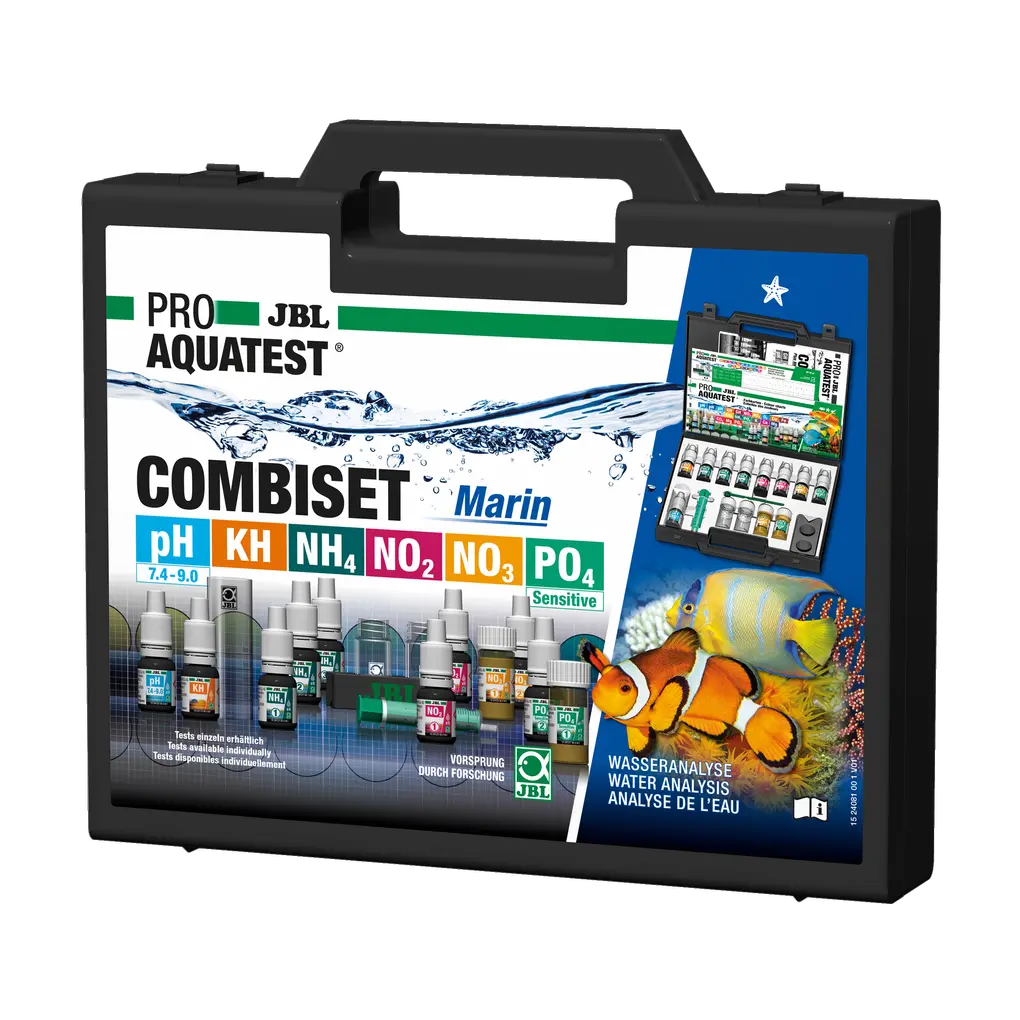
JBL PROAQUATEST COMBISET Marin

6 pruebas de agua para determinar de forma sencilla y precisa los valores más importantes del agua marina, especialmente para acuarios de peces.
Artikel-Nr. 2408117

64.42 EUR

Preis inkl. 21 MwSt zzgl. Versand
Händlersuche Gefahrenhinweise

Produktmerkmale

  • 6 test para el agua, para determinar de forma sencilla y exacta los parámetros más importantes en agua salada, especial para acuarios de peces
  • Fácil de usar: agregar indicador de color y comparar con escala de colores o contar las gotas hasta que cambie el color
  • Incluye test de dureza de carbonatos, valor del pH, amonio/amoniaco, nitrito, nitrato y fosfato
  • Frascos a prueba de niños, maletín de plástico resistente al agua, reactivos de relleno a la venta por separado
  • Incluye: maletín de plástico resistente al agua, 11 reactivos, bloque comparador, 3 cubetas, jeringuilla, cuchara dosificadora, escalas de colores, hojas de protocolo e instrucciones

Gefahrenhinweise

JBL NO3 2 - Sicherheitsinformationen gemäß GHS

Signalwort: Peligro

Gefahrensymbol

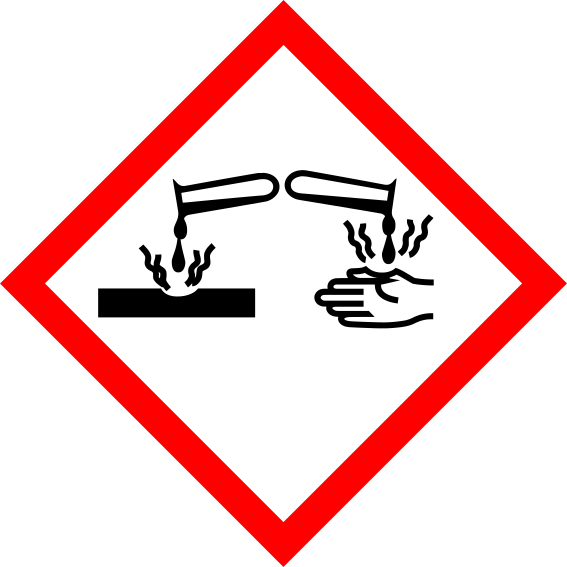
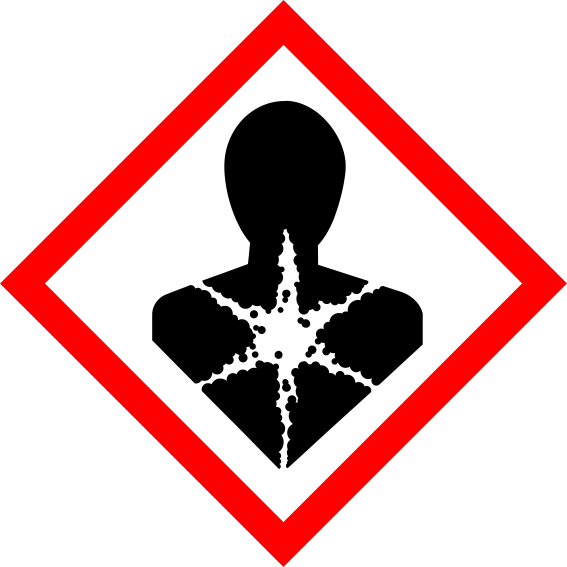
corrosive irritant health_hazard

Gefahrenhinweis

  • H318: Provoca lesiones oculares graves.
  • H314: Provoca quemaduras graves en la piel y lesiones oculares graves.
  • H341: Se sospecha que provoca defectos genéticos.
  • H317: Puede provocar una reacción alérgica en la piel.
  • H412: Nocivo para los organismos acuáticos, con efectos nocivos duraderos.

Sicherheitshinweise

  • P101: Si se necesita consejo médico, tener a mano el envase o la etiqueta.
  • P102: Mantener fuera del alcance de los niños.

Gefahrbestimmende Komponente

  • 7647-01-0/1: ácido clorhídrico
  • 541-69-5: m-fenilenodiamina, diclorhidrate

JBL NO3 1 - Sicherheitsinformationen gemäß GHS

Signalwort: Peligro

Gefahrensymbol

corrosive irritant environmental_hazard

Gefahrenhinweis

  • H318: Provoca lesiones oculares graves.
  • H314: Provoca quemaduras graves en la piel y lesiones oculares graves.
  • H317: Puede provocar una reacción alérgica en la piel.
  • H411: Tóxico para los organismos acuáticos, con efectos nocivos duraderos.

Sicherheitshinweise

  • P101: Si se necesita consejo médico, tener a mano el envase o la etiqueta.
  • P102: Mantener fuera del alcance de los niños.

Gefahrbestimmende Komponente

  • 87-69-4: ácido (+)-tartárico

JBL PO4 Sensitive 2 - Sicherheitsinformationen gemäß GHS

Signalwort: Peligro

Gefahrensymbol

corrosive irritant

Gefahrenhinweis

  • H318: Provoca lesiones oculares graves.
  • H314: Provoca quemaduras graves en la piel y lesiones oculares graves.
  • H302: Nocivo en caso de ingestión.
  • H335: Puede irritar las vías respiratorias.

Sicherheitshinweise

  • P101: Si se necesita consejo médico, tener a mano el envase o la etiqueta.
  • P102: Mantener fuera del alcance de los niños.

Gefahrbestimmende Komponente

  • 7647-01-0/1: ácido clorhídrico

JBL NO2 2 - Sicherheitsinformationen gemäß GHS

Signalwort: Atención

Gefahrensymbol

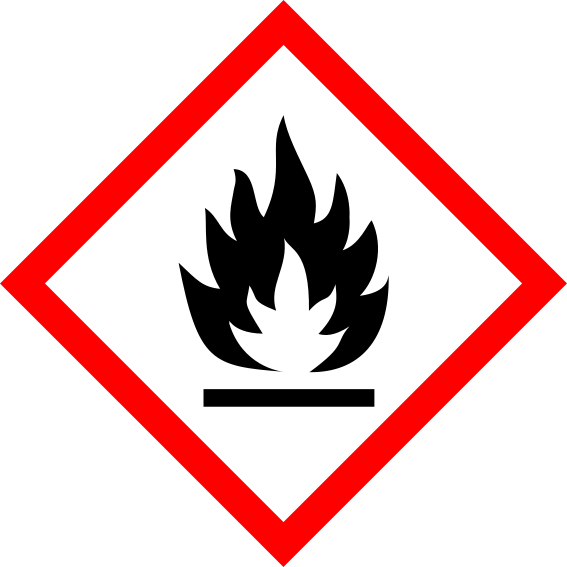
flammable irritant

Gefahrenhinweis

  • H319: Provoca irritación ocular grave.
  • H226: Líquidos y vapores inflamables.

Sicherheitshinweise

  • P101: Si se necesita consejo médico, tener a mano el envase o la etiqueta.
  • P102: Mantener fuera del alcance de los niños.

JBL NO2 1 - Sicherheitsinformationen gemäß GHS

Signalwort: Peligro

Gefahrensymbol

corrosive

Gefahrenhinweis

  • H318: Provoca lesiones oculares graves.
  • H314: Provoca quemaduras graves en la piel y lesiones oculares graves.

Sicherheitshinweise

  • P101: Si se necesita consejo médico, tener a mano el envase o la etiqueta.
  • P102: Mantener fuera del alcance de los niños.

Gefahrbestimmende Komponente

  • 64-19-7: ácido acético

JBL pH 7.4-9.0 - Sicherheitsinformationen gemäß GHS

Signalwort: Atención

Gefahrensymbol

flammable irritant

Gefahrenhinweis

  • H319: Provoca irritación ocular grave.
  • H226: Líquidos y vapores inflamables.

Sicherheitshinweise

  • P101: Si se necesita consejo médico, tener a mano el envase o la etiqueta.
  • P102: Mantener fuera del alcance de los niños.

JBL KH - Sicherheitsinformationen gemäß GHS

Signalwort: Peligro

Gefahrensymbol

flammable corrosive

Gefahrenhinweis

  • H226: Líquidos y vapores inflamables.
  • H318: Provoca lesiones oculares graves.
  • H314: Provoca quemaduras graves en la piel y lesiones oculares graves.

Sicherheitshinweise

  • P101: Si se necesita consejo médico, tener a mano el envase o la etiqueta.
  • P102: Mantener fuera del alcance de los niños.

JBL NH4 2 - Sicherheitsinformationen gemäß GHS

Signalwort: Peligro

Gefahrensymbol

corrosive environmental_hazard

Gefahrenhinweis

  • H318: Provoca lesiones oculares graves.
  • H314: Provoca quemaduras graves en la piel y lesiones oculares graves.
  • H411: Tóxico para los organismos acuáticos, con efectos nocivos duraderos.
  • H400: Muy tóxico para los organismos acuáticos.
  • EUH031: En contacto con ácidos libera gases tóxicos.

Sicherheitshinweise

  • P101: Si se necesita consejo médico, tener a mano el envase o la etiqueta.
  • P102: Mantener fuera del alcance de los niños.

Gefahrbestimmende Komponente

  • 7681-52-9/1: hipoclorito de sodio, solución
  • 1310-73-2: hidróxido de sodio

JBL NH4 3 - Sicherheitsinformationen gemäß GHS

Signalwort: Peligro

Gefahrensymbol

flammable irritant

Gefahrenhinweis

  • H319: Provoca irritación ocular grave.
  • H315: Provoca irritación cutánea.
  • H336: Puede provocar somnolencia o vértigo.
  • H225: Líquido y vapores muy inflamables.

Sicherheitshinweise

  • P101: Si se necesita consejo médico, tener a mano el envase o la etiqueta.
  • P102: Mantener fuera del alcance de los niños.

Gefahrbestimmende Komponente

  • 67-63-0: 2-propanol

Information and consent to cookies & third-party content

We use technically necessary cookies/tools to offer, operate and secure this service. Furthermore ,with your express consent , we use cookies/tools for marketing, tracking, creating personalised content on third-party sites and for displaying third-party content on our website. You can revoke your consent at any time with effect for the future via the menu item ‘Cookie settings’.
By clicking on ‘Allow all’, you give us your express consent to the use of cookies/tools to improve the quality and performance of our service, for functional and personalised performance optimisation, to measure the effectiveness of our ads or campaigns, for personalised content for marketing purposes, including outside our website. This enables us to provide personalised online ads and extended analysis options about your user behaviour. This also includes accessing and storing data on your device. You can revoke your consent at any time with effect for the future via the menu item ‘Cookie settings’.
You can use the ‘Change settings’ button to grant and revoke individual consent to the cookies/tools and receive further information on the cookies/tools we use, their purposes and duration.
By clicking on ‘Only absolutely necessary’, only technically necessary cookies/tools are used.

Our data protection declaration tells you how we process personal data and what purposes we use the data processing for.
PUSH messages from JBL

What are PUSH messages? As part of the W3C standard, web notifications define an API for end-user notifications that are sent to the user's desktop and/or mobile devices via the browser. Notifications appear on the end devices as they are familiar to the end user from apps installed on the device (e.g. emails). Notifications appear on the end user’s device, just like an app (e.g. for emails) installed on the device.

A notification makes it possible to inform the user about an event outside the context of a website, such as a new blog post, a competition or a voucher.

These notifications enable a website operator to contact its users whenever they have a browser open - it doesn’t matter whether the user is currently visiting the website or not.

To be able to send web push notifications, all you need is a website with a web push code installed. This allows brands without apps to take advantage of many of the benefits of push notifications (personalised real-time communications at just the right moment).

Web notifications are part of the W3C standard and define an API for end user notifications. A notification makes it possible to inform the user about an event, such as a new blog post, outside the context of a website.

JBL GmbH & Co. KG provides this service free of charge, and it is easy to activate or deactivate.