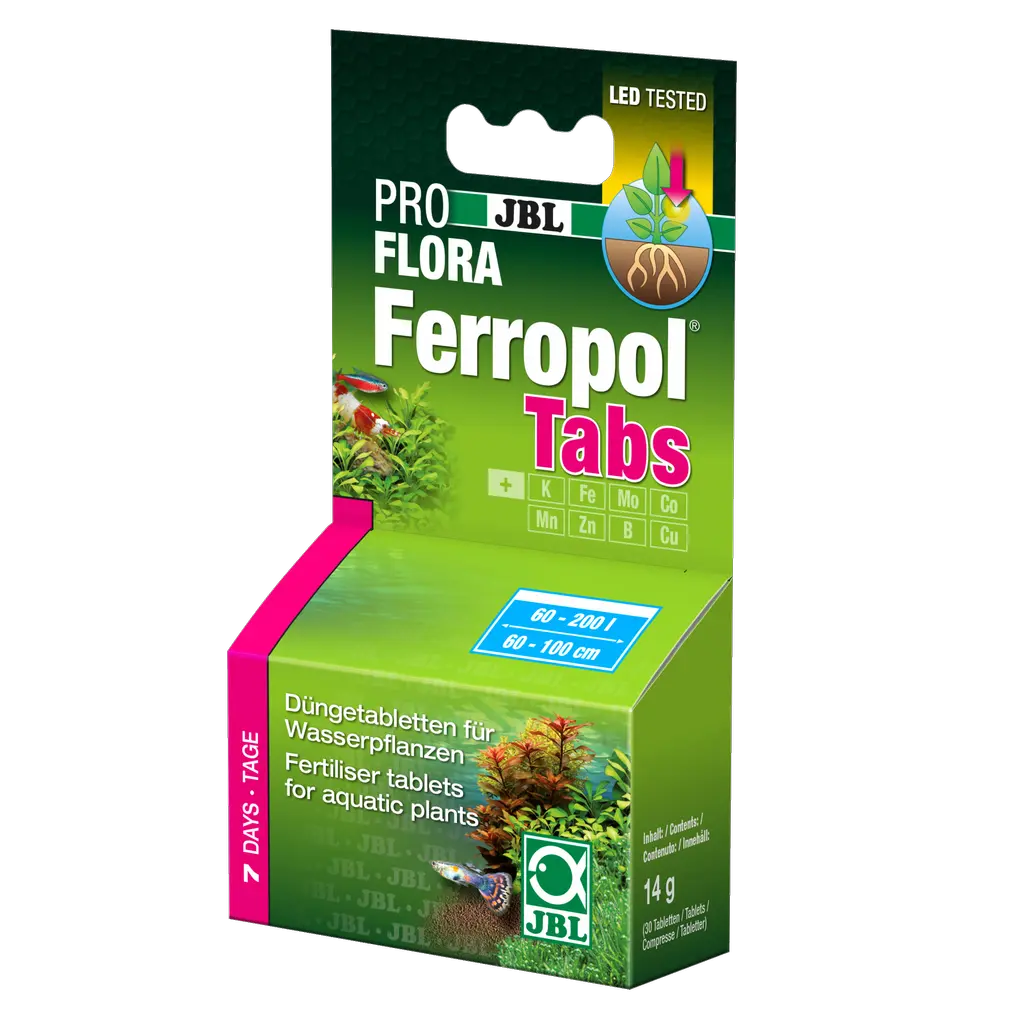
JBL PROFLORA Ferropol Tabs
Archived
Item no. 2020000
Product no longer available
Shop locator
In unserem FAQ‑Bereich findet ihr Antworten auf die am häufigsten gestellten Fragen. Solltet ihr hier nicht fündig werden, zögert bitte nicht, uns direkt zu kontaktieren – wir helfen euch gerne weiter.
Algae problems in an aquarium can never be traced to just one factor or general condition, and instead, are always the result of a combination of different factors, which include light, fertilization, water changes – specifically, how often and how much – feeding, fish population and, of course, the specific water parameters. _x000D_ _x000D_ According to analyses that were performed over a course of a number of years, red algae, at least the common brush algae and beard algae, occur in descending order at the following parameters: _x000D_ _x000D_ 1) too little carbon dioxide (in relationship to 100 % of the measured tank); the pH level should be in the slightly acetic range, depending on the carbonate hardness, in every case. _x000D_ 2) elevated phosphate levels (over 90 %); phosphate limitation by means of JBL PhosEx ultra is often helpful here. _x000D_ 3) too little and too irregular fertilization (there should always be traces of iron at least). _x000D_ 4) insufficient water changes; a weekly water change of over 30 % is recommended for algae problems. _x000D_ 5) not enough fast-growing plants._x000D_
Generally, one should never change plant fertilizers abruptly. The fertilizers from different manufacturers have somewhat different compositions in terms of trace elements. This may cause temporary nutrient changes. It is best to change over in 3 steps: _x000D_ _x000D_ 1) Reduction of the old fertilizer by 1/3; replace this with 1/3 of the new fertilizer. Wait approx. 3-4 weeks and observe the reaction of the plants. _x000D_ _x000D_ 2) Reduction of the old fertilizer by 2/3; replace this with 2/3 of the new fertilizer. Wait approx. 3-4 weeks and observe the reaction of the plants. _x000D_ _x000D_ 3) Complete discontinuation of the old fertilizer and change-over to the new fertilizer. _x000D_ _x000D_ It is important to observe the reaction of plant growth and, in addition, to check the iron content of the water at least 2x weekly. Whereas the value should never drop to 0, it should never exceed 0.2 mg/l if possible. However, short peaks are no cause for concern. _x000D_ _x000D_ These measures should generally be carried out on a weekly basis, ideally right after a water change. This achieves better results than fertilizing in large doses at longer intervals.
No, the active ingredients are bound in a cellulose matrix that does not dissolve immediately and ensures even distribution and addition. To do this, place the tablet in a spot with sufficient water movement and do not bury it. Refer to the instructions for use on your packaging for the quantity appropriate to your aquarium size.
Stelle deine Frage an das JBL Service Team.