Peru 2025

back to the worldmap overview

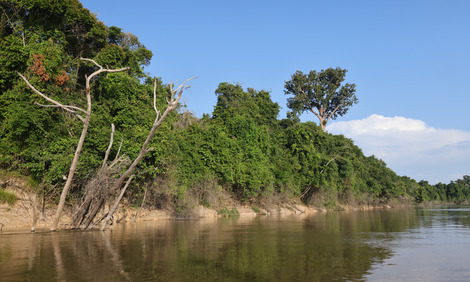
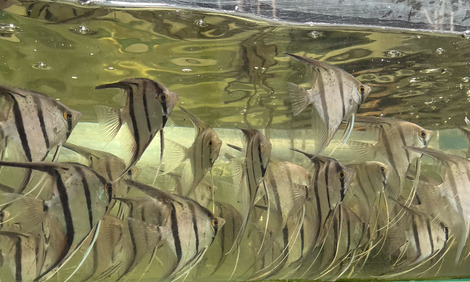
To the discus fish near Iquitos on the Amazon

Iquitos is the largest city in the world without road access – reachable only by plane or boat and situated directly at the fork between the Rio Nanay and the Amazon. Iquitos is a direct 1.5-hour flight away from Lima and provides an excellent base for exploring other destinations in the Peruvian Amazon lowlands.

Aqua-Terra facts

Fish found

Cichlids

Diskus, Crenicichla, Cichla, eartheaters, angelfish, Cichlasoma amazonarum, Hypselecara temporalis

Catfish

Corys, suckermouth catfish, banjo catfish, whiptail catfish, sturisoma, tiger shovelnose catfish

Characins

Predatory characins, bottom dwelling tetras, Buenos Aires tetras, metynnis, piranhas, freshwater hatchetfish

Electric eel

Freshwater stingray

Water values

Amazonas

°C: 30.5 / pH: 7.0 / GH: 5 / KH: 5 / conductance in µS/cm: 226 / O2: 10 mg/l

Rio Nanay

°C: 28-32 / pH: 5-6 / GH: 1-2 / KH: 0 / conductance in µS/cm: 4-7 / O2: 8-10 mg/l

Air values

Air temperature

31.5-34 °C

Humidity

50-77 %

Iquitos itself is quite an experience, though not necessarily a pleasant one. Even as you approach the city, you can see the sprawling metropolis with its 377,000 inhabitants in the greater Iquitos area – the largest city in the Peruvian rainforest. And these people need to be fed.

At the daily market in the centre of Iquitos, alongside fish, you can also find caiman and turtle meat.

People eat whatever nature (still) provides. It’s astonishing that this quantity of fish can still be caught anywhere in the area on a daily basis. Let’s see how much longer that lasts…

The moto taxis, known as tuk-tuks in other countries, are a familiar sight on the streets. In the hustle and bustle of the sometimes narrow streets, they are an ideal and affordable means of transport. The exhaust fumes would be a nightmare for any green politician! Even when it rains, the taxis keep drivers and passengers reasonably dry!

And when it rains, it really pours. Five metres without an umbrella, and you’re soaked to the skin. All you can do is succumb to the rain as just part of the experience. After all, it is called a tropical rainforest!

Technically, September should still be BEFORE the rainy season, but the climate has changed significantly, even in the tropics. In the past, the indigenous people could predict to the week exactly when the dry season would end and the rainy season begin. Nowadays it is not even possible to predict the month with any certainty.

The 36 participants in the 16-day JBL expedition were divided into three teams of 12 people each, so that there were never too many people at any one biotope at the same time. A team leader was assigned to make sure that his flock didn’t get lost and that all 12 returned to the camp or lodge in the evening.

The participants came mainly from Germany, but also from France, Austria, Croatia, the UK, the Netherlands and Switzerland. Just as varied as the nationalities were the individual participants’ areas of interest: discus, cichlids, frogs, insects, plants and many more. This brought together an incredible wealth of knowledge, which proved extremely helpful in identifying the animals and plants we found. The assistance provided by the world-renowned cichlid specialist Dr Wolfgang Staeck alone was fantastic.


    Der Rio Nanay – Heimat der Diskus

    Ein Schwerpunkt sollte die Suche nach Diskus im Rio Nanay sein. Der Rio Nanay ist ein Schwarzwasserfluss, aber leider trübe: 28-32 °C, Leitfähigkeit zwischen 4 und 7 µS/cm, einem pH-Wert von 5-6, keiner messbaren Karbonathärte und einer Gesamthärte von 1-2 °dGH.

    Find out more

    1.000 Aquarien beim größten Fischexporteur von Iquitos

    Nach der Rückfahrt nach Iquitos stand noch ein Besuch beim Fischexporteur auf dem Programm. Es ist ein völlig anderes Erlebnis, zwischen den rund 1.000 Aquarien von Stingray Aquarium, dem größten Zierfischexporteur von Iquitos, herumzulaufen und sich die vorrätigen Fische anzusehen, als dies in Europa zu tun.

    Find out more

Information and consent to cookies & third-party content

We use technically necessary cookies/tools to offer, operate and secure this service. Furthermore ,with your express consent , we use cookies/tools for marketing, tracking, creating personalised content on third-party sites and for displaying third-party content on our website. You can revoke your consent at any time with effect for the future via the menu item ‘Cookie settings’.
By clicking on ‘Allow all’, you give us your express consent to the use of cookies/tools to improve the quality and performance of our service, for functional and personalised performance optimisation, to measure the effectiveness of our ads or campaigns, for personalised content for marketing purposes, including outside our website. This enables us to provide personalised online ads and extended analysis options about your user behaviour. This also includes accessing and storing data on your device. You can revoke your consent at any time with effect for the future via the menu item ‘Cookie settings’.
You can use the ‘Change settings’ button to grant and revoke individual consent to the cookies/tools and receive further information on the cookies/tools we use, their purposes and duration.
By clicking on ‘Only absolutely necessary’, only technically necessary cookies/tools are used.

Our data protection declaration tells you how we process personal data and what purposes we use the data processing for.

PUSH messages from JBL

What are PUSH messages? As part of the W3C standard, web notifications define an API for end-user notifications that are sent to the user's desktop and/or mobile devices via the browser. Notifications appear on the end devices as they are familiar to the end user from apps installed on the device (e.g. emails). Notifications appear on the end user’s device, just like an app (e.g. for emails) installed on the device.

A notification makes it possible to inform the user about an event outside the context of a website, such as a new blog post, a competition or a voucher.

These notifications enable a website operator to contact its users whenever they have a browser open - it doesn’t matter whether the user is currently visiting the website or not.

To be able to send web push notifications, all you need is a website with a web push code installed. This allows brands without apps to take advantage of many of the benefits of push notifications (personalised real-time communications at just the right moment).

Web notifications are part of the W3C standard and define an API for end user notifications. A notification makes it possible to inform the user about an event, such as a new blog post, outside the context of a website.

JBL GmbH & Co. KG provides this service free of charge, and it is easy to activate or deactivate.