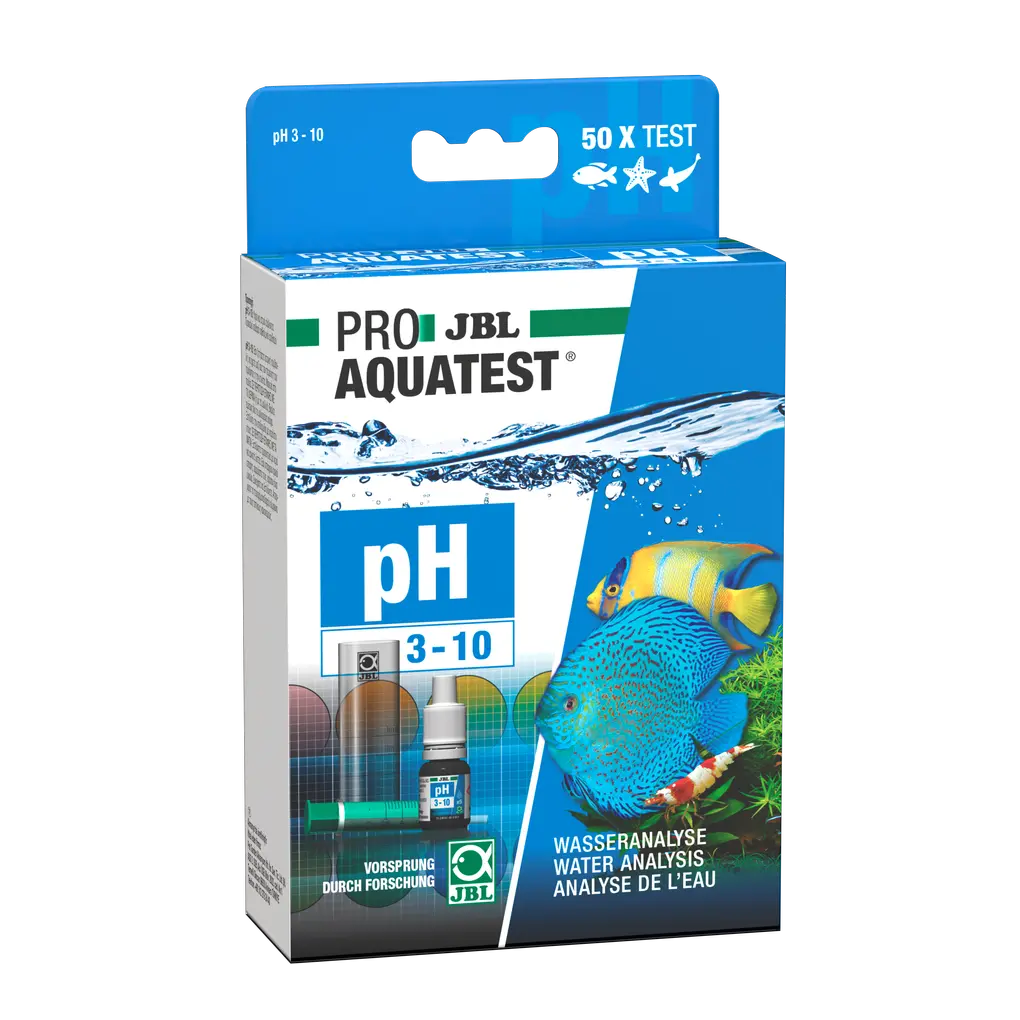
JBL PROAQUATEST pH 3.0 -10.0
In unserem FAQ‑Bereich findet ihr Antworten auf die am häufigsten gestellten Fragen. Solltet ihr hier nicht fündig werden, zögert bitte nicht, uns direkt zu kontaktieren – wir helfen euch gerne weiter.
The color charts are not available for download on the JBL website, as a color-calibrated printer is required to ensure accurate color reproduction, which is rarely the case in private households. You can find the color chart booklet as a spare part on the respective product page and in the spare parts shop at: https://www.jbl.de/de/produkte/detail/8732/jbl-proaquatest-sortiment-farbkarten
Please clean the glass thoroughly before installing the thermometer. Algae, biofilms, and limescale can prevent it from sticking properly. If the thermometer still does not stick, there may be a problem with the suction cup itself. Due to a material defect, some suction cups have bubble-like growths that prevent them from sticking properly. If you have one of these suction cups, please contact our customer service with a photo.
If you reach the end of the scale on the color chart with one measurement, you can extend the known scale several times by diluting with distilled water (e.g., JBL Dest) for the following tests. Here's how: Dilute the sample with distilled water and repeat the measurement. This works as follows: GH test: Use 10 ml of aquarium water instead of 5 ml. Now 1 drop corresponds to 0.5 °dGH. KH test: Use 10 ml of aquarium water instead of 5 ml. Now 1 drop corresponds to 0.5 °dGH. Note: When using 10 ml of sample water, the color development is weaker with the first few drops than when filling with 5 ml of sample water. For better readability, place the measuring vessel on a white surface. NH4/NH3 ammonium/ammonia, NO2 nitrite, Fe iron, and Cu copper: 2.5 ml sample + 2.5 ml distilled water: result x 2 Water: Result x 2 1 ml sample + 4 ml distilled water: Result x 5 0.5 ml sample + 4.5 ml distilled water: Result x 10 NO3 Nitrate, SiO2 Silicate, PO4 Phosphate sensitive and Mg Magnesium Freshwater: 5 ml sample + 5 ml distilled Water: Result x 2 2 ml sample + 8 ml distilled water: Result x 5 1 ml sample + 9 ml distilled water: Result x 10 PO4 Phosphate Koi High Range: 2.5 ml sample + 2.5 ml distilled water: Result x 2 1 ml sample + 4 ml distilled water: Result x 5 K Potassium: 7.5 ml sample + 7.5 ml distilled water: Result x 2 3 ml sample + 12 ml distilled water: Result x 5 1.5 ml sample + 13.5 ml distilled water: Result x 10 K Potassium in seawater: 1. 10 ml sample water with distilled water to 300 ml. 2. The remaining steps are the same as for freshwater. 3. Multiply the test result by a factor of 30. CO2 direct, Ca calcium, and Mg+Ca magnesium+calcium: Not required.
As a general rule, opened test reagents have a shorter shelf life than those in their original packaging. The extent to which the shelf life is reduced depends largely on how the reagents are handled and stored. It is therefore quite possible that a reagent will no longer work properly after nine months. However, further information is required to assess this
After a new installation, the bubbles will only flow slowly through the reactor and will partially combine to form large bubbles. The device requires a running-in period of approx. 48 hours! Only then will a biofilm have formed on the surface of the device, allowing the bubbles to pass through to the top without any problems. After the running-in period, set the bubble rate required for your aquarium.
With JBL PROAQUATEST drop tests, you have a laboratory comparator system that compensates for the natural coloration of the water and enables non-chemists to perform accurate and reliable water analysis. To ensure that water testing monitors the health of your fish and provides the greatest possible safety, you will find a customized evaluation for three different applications. Above the different colored measuring points are numbers, three symbols, and a colored band. The symbols represent the following areas of application: Fish = Freshwater Koi = Garden pond Starfish = Saltwater The color band indicates the meaning of the measured value in green (everything OK), yellow (caution) and red (action required). In addition, you will find numbers that indicate the value in mg/l for the respective color field. The first two color strips (freshwater and pond) belong to the upper row of numbers, while seawater belongs to the lower row. Why do the values differ? Due to the high salt concentration in seawater, the color of the reaction is not as intense as in freshwater (including ponds). Consequently, the value is higher than in freshwater for the same color. Why do the recommendations differ? Each habitat reacts differently to certain nutrient concentrations. In garden ponds, for example, constantly changing temperatures and light intensity can make the value more critical than in freshwater, where these factors are constant and necessary additives ensure balance, which are not added to ponds. Therefore, the recommendations are green for one area of application and yellow for another.
There is one tip for feeding PlanktonPur that solves all problems. Open the stick, hold it upside down in front of the filter outlet in the water flow and press the stick repeatedly. The opening of the stick is under water, which means that it empties completely and is distributed well by the water flow.
Have you lost your log sheets, already filled them all out, or need them in a different language? Attached to this FAQ, you will find a PDF file that you can print out in German, English, and French.
Stelle deine Frage an das JBL Service Team.