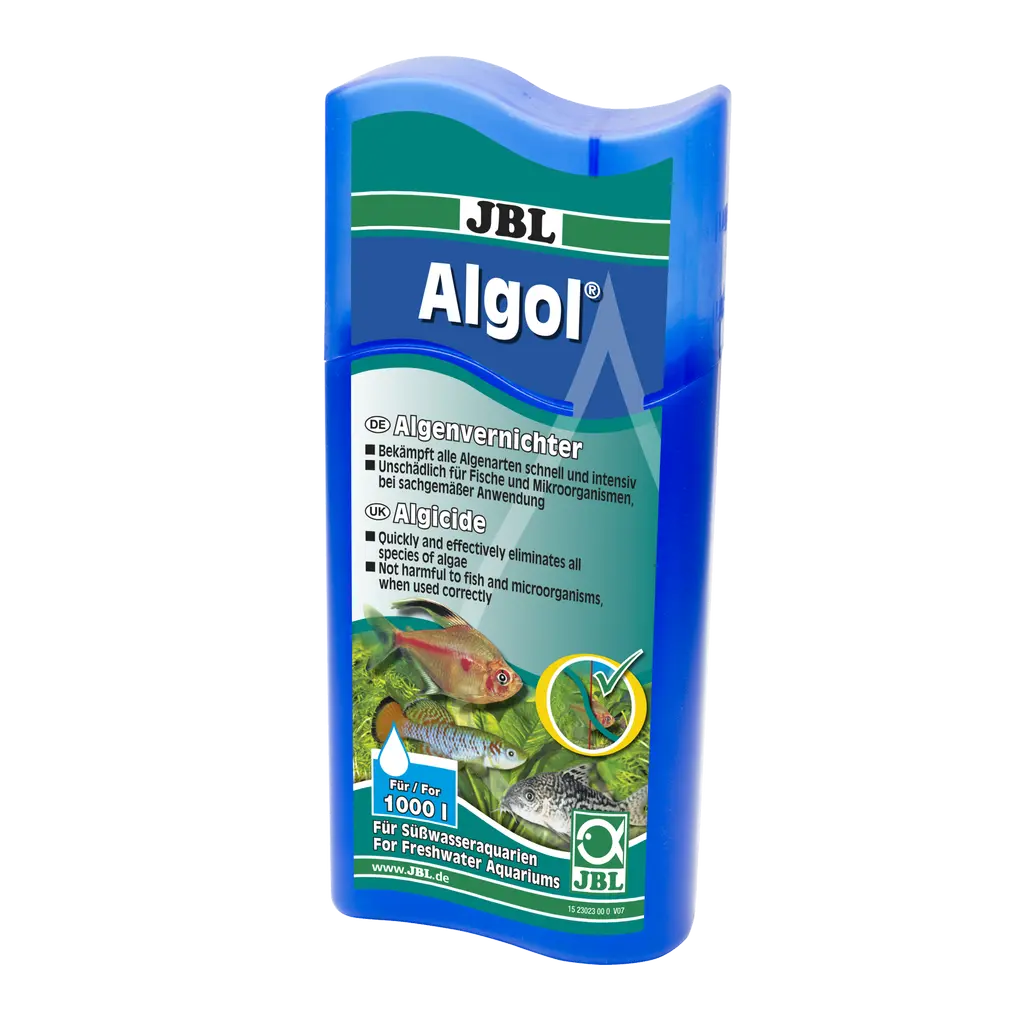
JBL Algol 250ml

For beautiful freshwater aquariums: Intensively combats all types of algae (including green water = suspended algae)
Item no. 2302300

Use biocides safely. Always read the label and product information before use.

Registered at the Federal Institute for Occupational Safety and Health under BAUA number N-19236
Baua no. for JBL Algol

21.97 EUR

Price incl. 23 VAT plus Delivery
Base price 87.88 EUR / l
In stock – delivered to you in 1-3 business days
Shop locator Hazard statements

Product features

  • For beautiful freshwater aquariums: Intensively combats all types of algae (including green water = suspended algae)
  • Ideally apply in the morning (low pH). Recommended before use: change 30% of the water. Ensure sufficient oxygen content during use by aerating the water. Repeat after 5 days if necessary
  • Against all types of algae in freshwater aquariums. Copper-free!
  • Harmless to fish and microorganisms when used properly
  • Contents: 1 bottle of Algol. Application: 10 ml/40 l water. Example: 60 l aquarium: 15 ml

Noch offene Fragen?

In unserem FAQ‑Bereich findet ihr Antworten auf die am häufigsten gestellten Fragen. Solltet ihr hier nicht fündig werden, zögert bitte nicht, uns direkt zu kontaktieren – wir helfen euch gerne weiter.

  • What happens to the algae after using an algae control product?

    Any algae control product that kills algae, such as JBL AlgoPond forte, AlgoPond green, or Algol, causes the dead algae to decompose biologically and be broken down by bacteria. This in turn leads to enormous oxygen consumption by the bacteria (nitrification) and the release of the nutrients nitrate and phosphate, which were "bound" in the algae. In principle, this feeds the next generation of algae. This is why JBL always recommends binding the released nutrients as the final step in algae control after targeted treatment with an algae product. Since it is sufficient to remove one of the two nutrients, we recommend phosphate removal, which can be done very easily with a good phosphate remover (JBL PhosEx Pond or JBL PhosEx). Incidentally, it therefore always makes sense to remove dying or dead algae mechanically. The less algae is broken down, the fewer nutrients are released again!

    War diese Antwort hilfreich?
  • When should I change the water when using the JBL Algol algae remover?

    Start using the algae treatment by changing at least 30% of the water, as described on the product label. If the algae are stubborn, you can add another dose after 5 days. This means you'll need to change the water again before adding another dose. If you don't repeat the treatment, it's still a good idea to change the water to reduce the amount of dead algae in the tank.

    War diese Antwort hilfreich?
  • I have a lot of algae in my cichlid aquarium. Unfortunately, a single application of JBL Algol had no effect.

    Regarding algae in cichlid aquariums. This is a permanent problem, as there is always an excess of nutrients in aquariums with few plants. JBL Algol may need to be dosed several times, for example at weekly intervals. Please carry out a 50% water change beforehand and ensure that the aquarium is well aerated.

    War diese Antwort hilfreich?
  • How do mosses react to JBL Algol?

    Depending on the species, mosses may be sensitive to Algol; this is certainly the case with moss balls. Dwarf shrimp may also react sensitively to Algol; our experience varies depending on the species. In addition, there are the general water values to consider.

    War diese Antwort hilfreich?
  • Is JBL Algol harmful to my shrimp?

    With JBL Algol, negative effects on freshwater shrimp, especially more sensitive dwarf shrimp, cannot be ruled out.

    War diese Antwort hilfreich?
  • Can I kill blue-green algae with JBL Algol?

    Blue-green algae are a somewhat complicated topic. Blue-green algae are bacteria, as is well known. They perform photosynthesis just like plants. Blue-green algae are among the oldest organisms in the world and should have died out long ago if it weren't for a few special characteristics, one of which is their ability to influence the medium in which they live to their advantage, i.e., to manipulate environmental parameters (something not many organisms can do). This characteristic has ensured their survival. In nature, blue-green algae are usually niche dwellers that are always inferior to other organisms. Like all plants, blue-green algae need light and nutrients. However, blue-green algae also need a settlement substrate on which to grow. They are inferior to "normal" biofilms in nature and in aquariums and can only spread if there has been a disturbance and partial death of the "normal" biofilm. They then settle quickly and subsequently overgrow the "normal" biofilm. Since they change the water parameters beneath their own layer, the normal biofilm dies off over a large area and the blue-green algae aquarium is born. Algae agents are only of limited use against blue-green algae. The only method that really helps at present is complete light deprivation, to which they are very sensitive.

    War diese Antwort hilfreich?
  • How often can JBL Algol be dosed?

    When using JBL Algol repeatedly, we recommend waiting 7 days between applications. Before reapplying, be sure to change 50-70% of the water. Please note that harmful effects on aquatic plants cannot be ruled out with repeated use. Furthermore, JBL Algol does not eliminate the cause of emerging algae growth. In this case, the care conditions should be checked.

    War diese Antwort hilfreich?

Antwort nicht gefunden?

Stelle deine Frage an das JBL Service Team.

Hazard statements

JBL Algol 250ml - Safety information according to GHS

Hazard statement(s)

  • H412: Harmful to aquatic life with long lasting effects.

Safety instructions

  • P273: Avoid release to the environment.
  • P101: If medical advice is needed, have product container or label at hand.
  • P102: Keep out of reach of children.
  • P501a: Dispose of contents/container in accordance with local regulations.
  • P103: Read carefully and follow all instructions.

Information and consent to cookies & third-party content

We use technically necessary cookies/tools to offer, operate and secure this service. Furthermore ,with your express consent , we use cookies/tools for marketing, tracking, creating personalised content on third-party sites and for displaying third-party content on our website. You can revoke your consent at any time with effect for the future via the menu item ‘Cookie settings’.
By clicking on ‘Allow all’, you give us your express consent to the use of cookies/tools to improve the quality and performance of our service, for functional and personalised performance optimisation, to measure the effectiveness of our ads or campaigns, for personalised content for marketing purposes, including outside our website. This enables us to provide personalised online ads and extended analysis options about your user behaviour. This also includes accessing and storing data on your device. You can revoke your consent at any time with effect for the future via the menu item ‘Cookie settings’.
You can use the ‘Change settings’ button to grant and revoke individual consent to the cookies/tools and receive further information on the cookies/tools we use, their purposes and duration.
By clicking on ‘Only absolutely necessary’, only technically necessary cookies/tools are used.

Our data protection declaration tells you how we process personal data and what purposes we use the data processing for.
PUSH messages from JBL

What are PUSH messages? As part of the W3C standard, web notifications define an API for end-user notifications that are sent to the user's desktop and/or mobile devices via the browser. Notifications appear on the end devices as they are familiar to the end user from apps installed on the device (e.g. emails). Notifications appear on the end user’s device, just like an app (e.g. for emails) installed on the device.

A notification makes it possible to inform the user about an event outside the context of a website, such as a new blog post, a competition or a voucher.

These notifications enable a website operator to contact its users whenever they have a browser open - it doesn’t matter whether the user is currently visiting the website or not.

To be able to send web push notifications, all you need is a website with a web push code installed. This allows brands without apps to take advantage of many of the benefits of push notifications (personalised real-time communications at just the right moment).

Web notifications are part of the W3C standard and define an API for end user notifications. A notification makes it possible to inform the user about an event, such as a new blog post, outside the context of a website.

JBL GmbH & Co. KG provides this service free of charge, and it is easy to activate or deactivate.