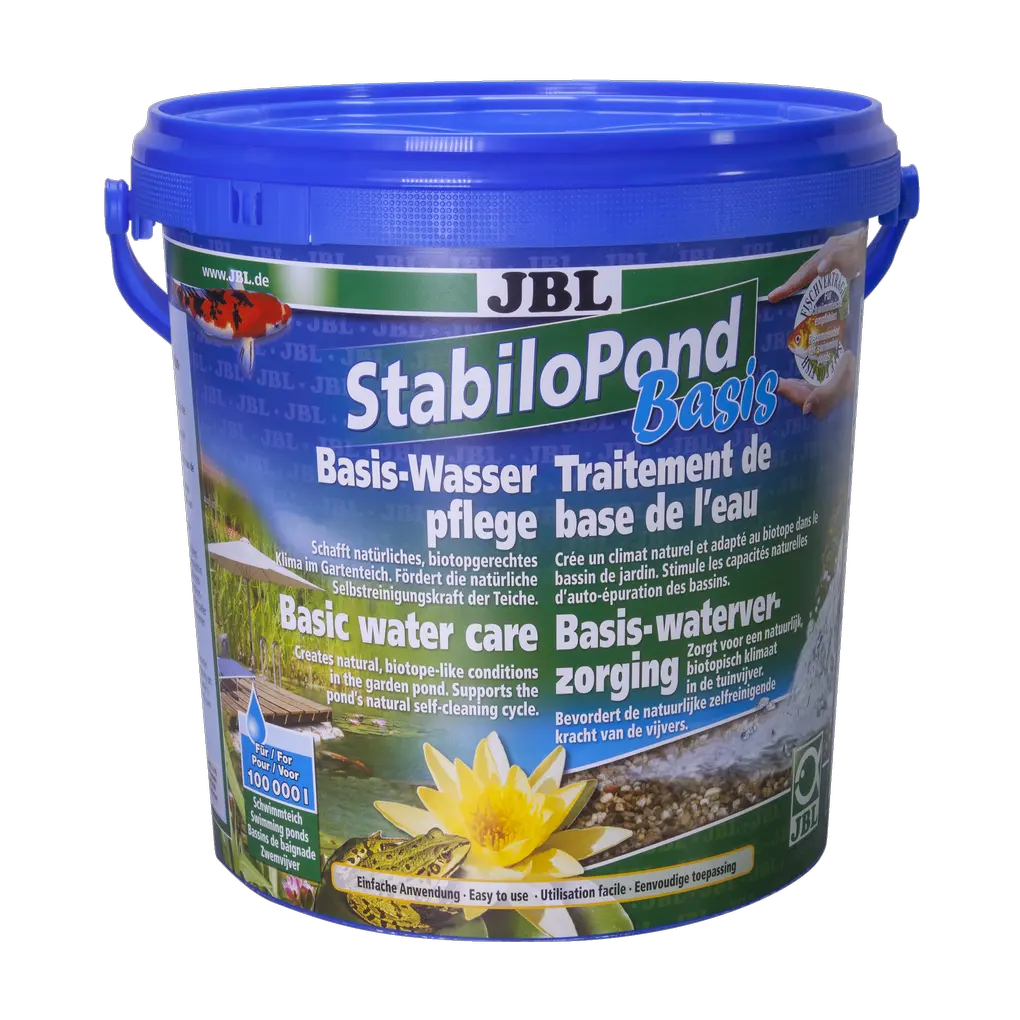
JBL StabiloPond Basis 10kg
Archived
Item no. 2731400
In unserem FAQ‑Bereich findet ihr Antworten auf die am häufigsten gestellten Fragen. Solltet ihr hier nicht fündig werden, zögert bitte nicht, uns direkt zu kontaktieren – wir helfen euch gerne weiter.
JBL StabiloPond Basis raises the total hardness and carbonate hardness equally, JBL StabiloPond KH raises the total hardness to carbonate hardness in a ratio of 1:2
The required dosage depends on several factors: 1) The existing carbonate hardness For a carbonate hardness of 0-2 °dKH, you need 200 g/1,000 l of pond water. For a carbonate hardness of 2-4 °dKH, you need 100 g/1,000 l of pond water. 2) Processes in the garden pond that consume carbonate hardness In the event of algae blooms (floating or thread algae) and insufficient water stabilization, a higher or repeated dosage may be necessary, as the algae begin biogenic decalcification within a very short time after adding JBL StabiloPond Basis. In the event of heavy sedimentation, the components of JBL StabiloPond Basis are also processed by microorganisms at the bottom of the pond. In this case, a higher or repeated dosage may also be necessary.
JBL StabiloPond Basis and JBL StabiloPond KH are salt mixtures that stabilize (increase) the total hardness and carbonate hardness. They do not contain any nutrients that are available to algae. Nevertheless, it may appear that algae grow faster after adding JBL StabiloPond. This is because in most cases pond water does not contain enough minerals for the organisms living in it. If these missing minerals are added to the water, the supply situation for all organisms, including algae, improves as long as other nutrients available to algae are present, which is always the case. Some types of algae can store up to 100,000 times their own requirements in phosphate reserves.
JBL StabiloPond Basis is dosed as follows: Regularly every 2 months (Central European conditions with 500–1,000 mm precipitation per year). For initial use or carbonate hardness 0, dose 200 g/1,000 l pond water. For subsequent applications, 100 g/1,000 l pond water is sufficient. Sprinkle the powder into the pond. Do not dissolve in water beforehand, as this will cause foaming and reduce the stabilizing effect on the pond water
The water in garden ponds constantly loses minerals through various processes, including hydrogen carbonate, which acts as a buffer for the pH value. These processes are as follows: Precipitation: Precipitation is free of hardness and dilutes the pond water, reducing both the total hardness and the carbonate hardness. Biogenic decalcification: When there is a lack of carbon dioxide in the water, some plants, especially algae, can meet their CO₂ requirements through biogenic decalcification: Ca(HCO₃)2 (only dissolved) <-> CaCO₃ (precipitates as lime) + H₂O + CO₂ Lime precipitates as a by-product, and both carbonate and total hardness decrease. Nitrification in the filter: Nitrite is produced during nitrification by filter bacteria. Nitrite is the salt ion of nitrous acid. The acid ion (H+) is also excreted and reacts with hydrogen carbonate in the water: H+ (acid cation) + HCO₃- (hydrogen carbonate) <-> H₂O + CO₂ Nitrification therefore consumes hydrogen carbonates, causing the carbonate hardness to decrease. Mineral consumption by plants and animals: All organisms need minerals for their metabolism and growth, including calcium, magnesium, and others. This means that the total hardness in garden ponds decreases due to plants, bacteria, algae, insects, snails, mussels, other invertebrates, and fish. JBL StabiloPond Basis adds the necessary minerals (including calcium and magnesium) to garden ponds in equal amounts and is not designed solely to increase carbonate hardness. Depending on rainfall, which varies from year to year and also from region to region, regular re-dosage is required to varying degrees. In Central Europe, regular doses of JBL StabiloPond Basis every 2 months are sufficient; with higher rainfall, re-dosage may be necessary every 4-6 weeks. Use JBL PondCheck to check the water
StabiloPond Basis and KH always increase the hardness, always and without exception. If the hardness does not increase measurably, there are only three possible reasons: - The pond has no filtration or circulation. This leads to stratification of the water, with the hardened water settling at the bottom of the pond. - The products were underdosed. - Hardening took place, but the values drop again quickly. The latter is particularly possible in cases of heavy sludge accumulation and algae infestations. It is similar to microbes and algae living on a low flame, so to speak, when the water is not sufficiently stable, as they lack the necessary minerals, in this case calcium, magnesium, and especially hydrogen carbonates, just like all other organisms in the pond. Figuratively speaking, the microbes and algae rush directly to the dissolving salts in StabiloPond basis and KH and immediately begin to process them. This effect can occur in ponds with high organic loads (sludge) and massive algae blooms. In the latter case, algae treatment is essential.
Each JBL algae treatment has a specific purpose. It is therefore not necessary to use several AlgoPond products at the same time. Use AlgoPond Green against green water. For thread algae and all other types of algae, use AlgoPond forte. If you want to change products, wait 14 days, change at least 50% of the water and filter through activated carbon. StabiloPond and PhosEx can of course be used together with an AlgoPond algae treatment in accordance with the 1-2-3 algae-free principle.
Stelle deine Frage an das JBL Service Team.