JBL PROAQUATEST pH 6.0-7.6
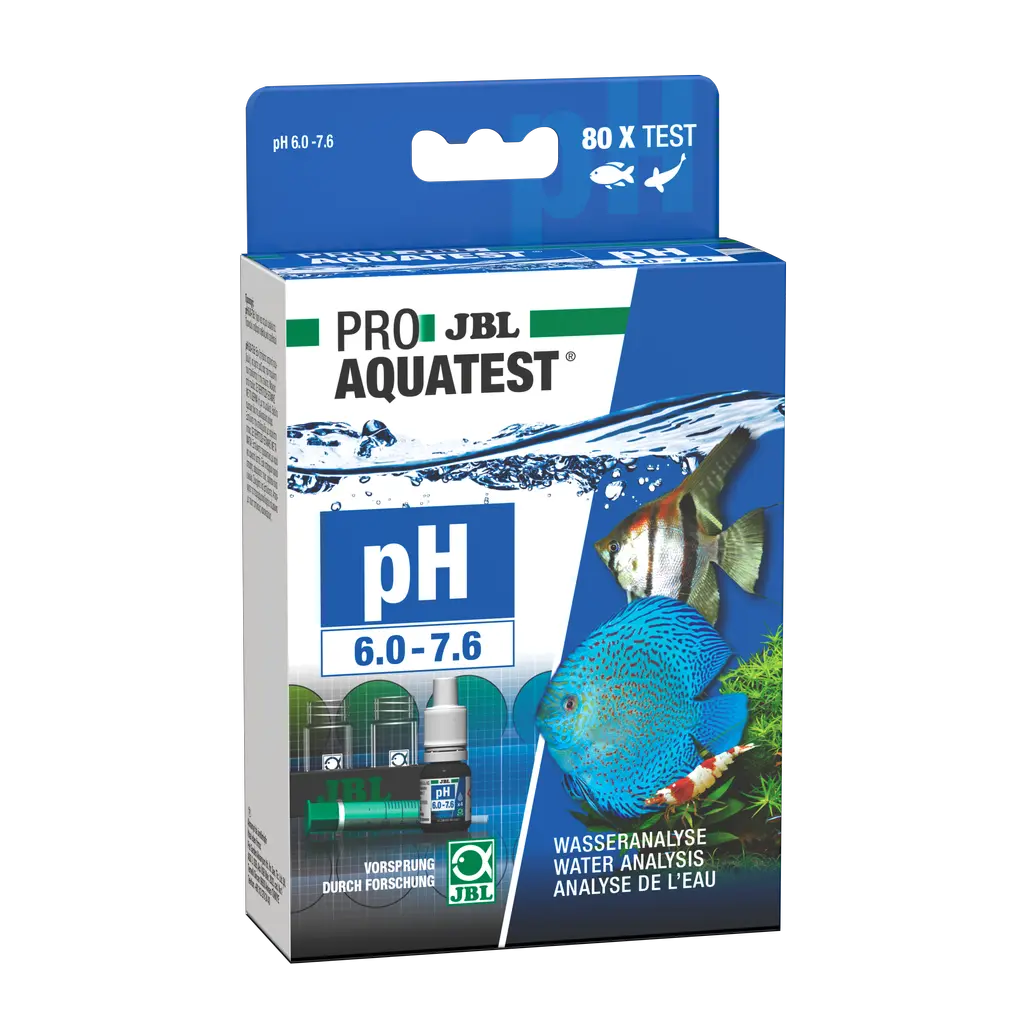
Item no. 2410317
In unserem FAQ‑Bereich findet ihr Antworten auf die am häufigsten gestellten Fragen. Solltet ihr hier nicht fündig werden, zögert bitte nicht, uns direkt zu kontaktieren – wir helfen euch gerne weiter.
If you reach the end of the scale on the color chart with one measurement, you can extend the known scale several times by diluting with distilled water (e.g., JBL Dest) for the following tests. Here's how: Dilute the sample with distilled water and repeat the measurement. This works as follows: GH test: Use 10 ml of aquarium water instead of 5 ml. Now 1 drop corresponds to 0.5 °dGH. KH test: Use 10 ml of aquarium water instead of 5 ml. Now 1 drop corresponds to 0.5 °dGH. Note: When using 10 ml of sample water, the color development is weaker with the first few drops than when filling with 5 ml of sample water. For better readability, place the measuring vessel on a white surface. NH4/NH3 ammonium/ammonia, NO2 nitrite, Fe iron, and Cu copper: 2.5 ml sample + 2.5 ml distilled water: result x 2 Water: Result x 2 1 ml sample + 4 ml distilled water: Result x 5 0.5 ml sample + 4.5 ml distilled water: Result x 10 NO3 Nitrate, SiO2 Silicate, PO4 Phosphate sensitive and Mg Magnesium Freshwater: 5 ml sample + 5 ml distilled Water: Result x 2 2 ml sample + 8 ml distilled water: Result x 5 1 ml sample + 9 ml distilled water: Result x 10 PO4 Phosphate Koi High Range: 2.5 ml sample + 2.5 ml distilled water: Result x 2 1 ml sample + 4 ml distilled water: Result x 5 K Potassium: 7.5 ml sample + 7.5 ml distilled water: Result x 2 3 ml sample + 12 ml distilled water: Result x 5 1.5 ml sample + 13.5 ml distilled water: Result x 10 K Potassium in seawater: 1. 10 ml sample water with distilled water to 300 ml. 2. The remaining steps are the same as for freshwater. 3. Multiply the test result by a factor of 30. CO2 direct, Ca calcium, and Mg+Ca magnesium+calcium: Not required.
The color charts are designed for use with the comparator block. When using the comparator block with the blind water sample, any self-coloring of the water is compensated for. Without using the comparator block, deviations in the reading are therefore to be expected.
No, it is not necessary to replace the JBL BioNitratEx filter balls for nitrate removal. The balls are broken down by bacteria and the carbon source they contain is used for nitrate removal. After 6 months, you should therefore refill the missing amount (1 ball per 2-3 liters of water). Please do not remove the remaining balls, as they serve to inoculate the newly added balls. Please note that the balls should be embedded in a layer of fine filter fleece so that the smallest particles from the decomposition do not enter the other filter material. In saltwater, the additional use of activated carbon is recommended to prevent initial cloudiness.
No, because this can destroy your pressure reducer. For safe operation, all storage cylinders must be used in an upright position. Never lay them down or turn them upside down.
The color charts are not available for download on the JBL website, as a color-calibrated printer is required to ensure accurate color reproduction, which is rarely the case in private households. You can find the color chart booklet as a spare part on the respective product page and in the spare parts shop at: https://www.jbl.de/de/produkte/detail/8732/jbl-proaquatest-sortiment-farbkarten
Stelle deine Frage an das JBL Service Team.