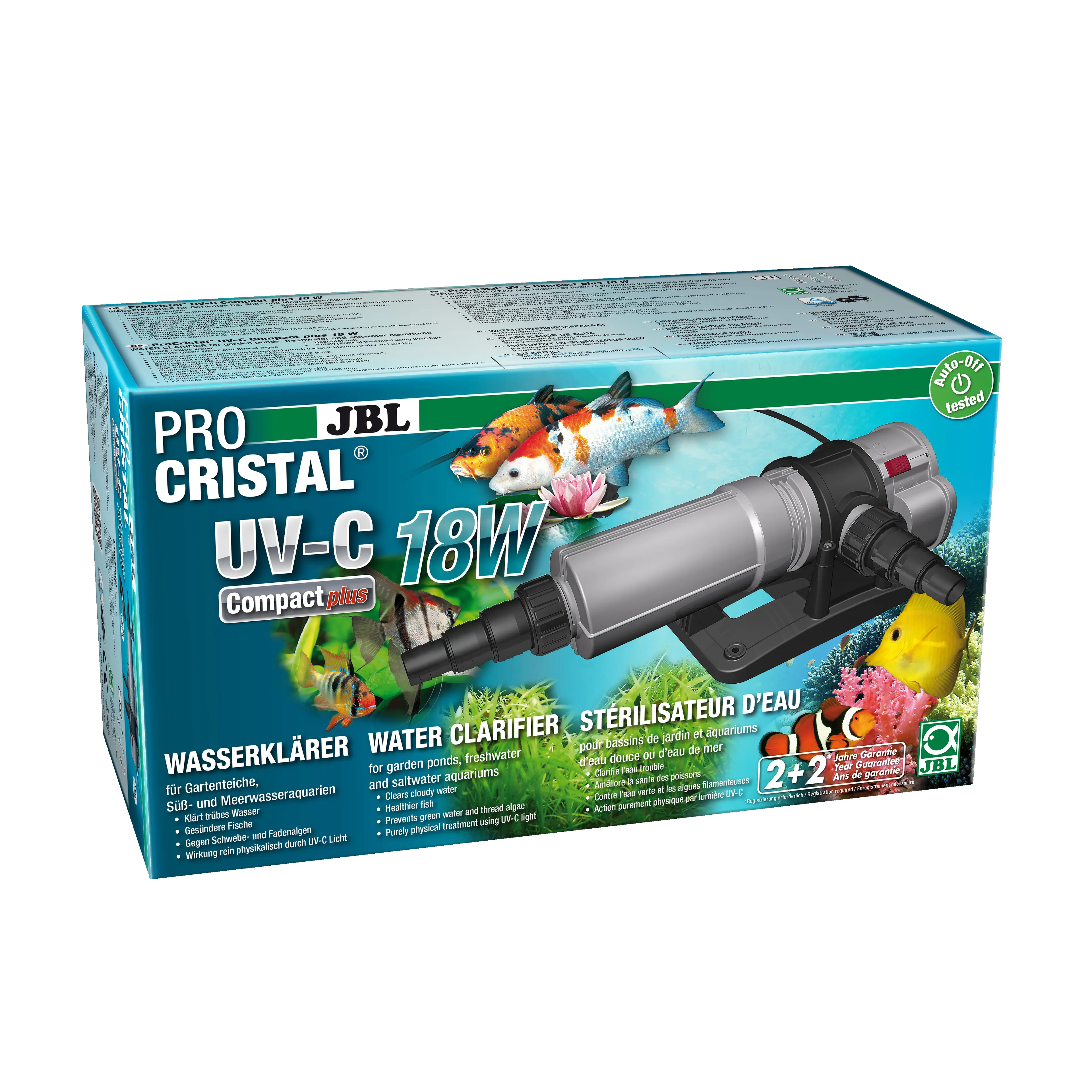
JBL PROCRISTAL UV-C Compact plus 18 W
In unserem FAQ‑Bereich findet ihr Antworten auf die am häufigsten gestellten Fragen. Solltet ihr hier nicht fündig werden, zögert bitte nicht, uns direkt zu kontaktieren – wir helfen euch gerne weiter.
Green water is caused by suspended algae, which grow due to a lack of competition from other plants and, above all, due to high nutrient levels in the water caused by animal excrement. The filter will not be able to do much to change this. Ultimately, there are only two options. 1. Change the water much more frequently to remove the nutrients from the animal excrement. 2. A JBL PROCRISTAL UV-C Compact plus will kill the suspended algae. You can also turn off the light for 2-3 days, as this will stop the algae from photosynthesizing.
Water tests can be stored next to a UV-C device without any problems.
If you have problems with bacterial infections in animals, we recommend continuous use of the JBL PROCRISTAL UV-C Compact plus. This is the only way to achieve an effective reduction in the germ density in the water. If there are no cases of disease, use can be limited to 12 hours per day.
Yes, that makes sense. Bacteria such as JBL Denitrol or JBL PROCLEAN BAC need some time to settle on the substrate and float freely in the water until then, so that the UV-C rays would kill them. It is therefore advisable to switch off the UV-C device for one day.
How often a UV-C lamp, for example in JBL PROCRISTAL UV-C Compact plus devices, needs to be replaced depends on the operating system. After a maximum of 6000–8000 operating hours, the performance has decreased to such an extent that replacement is necessary. In continuous operation (24 hours), replacement is necessary after 250 days. For this reason, replacement in ponds is always carried out in the spring when the equipment is put back into operation.
A UV-C device is always connected to the pump outlet to ensure flow. In most pond filters (with the exception of pressure filters), the filter container is higher than the pond water level, and the water flows back into the pond by gravity. The pond pump is located in the pond. To prevent water from accumulating in the UV-C device, it must therefore be installed between the pump and the filter unit.
Flow rate refers to the actual flow through the UV-C clarifier. If the UV-C clarifier is connected behind the filter, all of the water pumped by the filter flows through the clarifier and the sterilizing effect lasts considerably longer (in relation to the total volume of water in the aquarium). For powerful filters, we recommend either separate installation using a small circulation pump or operation in bypass mode. This means connecting the filter outlet to a Y-piece (to separate the water), then installing the clarifier in one circuit and connecting the two hoses again via a second Y-piece, from where the water then flows back into the aquarium.
No, this small ball is made of mercury and is absolutely necessary. The burner is only defective if the ignition wire is broken. After the lamp has been lit, the temperature inside rises and liquefies this small ball, producing mercury vapor. The ionization processes triggered by this provide the desired UV-C radiation to kill germs, bacteria, and algae. Due to their mercury content, used UV-C burners must only be disposed of at appropriate collection points (e.g., for fluorescent tubes).
With partial disinfection, bacteria are easier to combat than cloudiness caused by suspended algae, as the cell structure of bacteria is very simple. This means that the cells of bacteria are easier to destroy than those of algae.
The question itself sounds strange, so the answer is hardly surprising. No, don't do that under any circumstances. If a seal is not tight, it may already be too old or defective. Two seals on top of each other take up too much space and do not improve the seal; in fact, they make it worse. You should therefore replace a seal that is not working properly. By the way: You can maintain your seals and significantly improve their service life with JBL SiliconeSpray.
With the JBL PROCRISTAL UV-C QuickConnect, you can connect all JBL PROCRISTAL UV-C devices to each other. It does not matter whether they have the same power output.
It is not possible to say how long the UV-C device should be operated each day based on distance alone, as this would require knowledge of the germ load and germ density regeneration in the aquarium. However, based on experience, we would not operate the device for less than 12 hours per day. Continuous operation would be better in terms of the durability of the burner.
When using medication, the UV-C water clarifier must be switched off.
UV-C light breaks down the chelators in fertilizers that prevent the precipitation of trace elements such as iron, but also some others. When using a UV-C clarifier, it is therefore advisable to switch to daily fertilization, for example JBL PROFLORA Ferropol 24, converting the standard dose to a daily dose at the beginning. It may be necessary to increase the fertilizer dose slightly. Before the next fertilizer application, iron should be measurable at least in trace amounts. Vitamins and other higher-quality organic compounds are also broken down, so twice-weekly dosing of vitamins, for example with JBL Atvitol, via the food is recommended.
Deposits (dirt, limescale, etc.) inside the housing prevent the UV-C water clarifier from working optimally. The device should therefore be cleaned inside twice a year, or more often if the clarifying effect noticeably diminishes.
No, unfortunately that is not possible. However, you have the option of connecting a second JBL PROCRISTAL UV-C Compact plus device to a 5 W device via the JBL PROCRISTAL UV-C QuickConnect.
A JBL ProCristal UV-C clarifier consists of a UV-C lamp and an electronic ballast. The ballast also requires a small amount of power, so the total power consumption of the UV-C clarifier is slightly higher than the power converted into UV-C light. For more information, please refer to the type plate and the instructions for use.
Stelle deine Frage an das JBL Service Team.