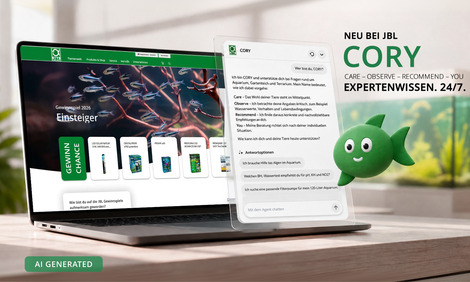
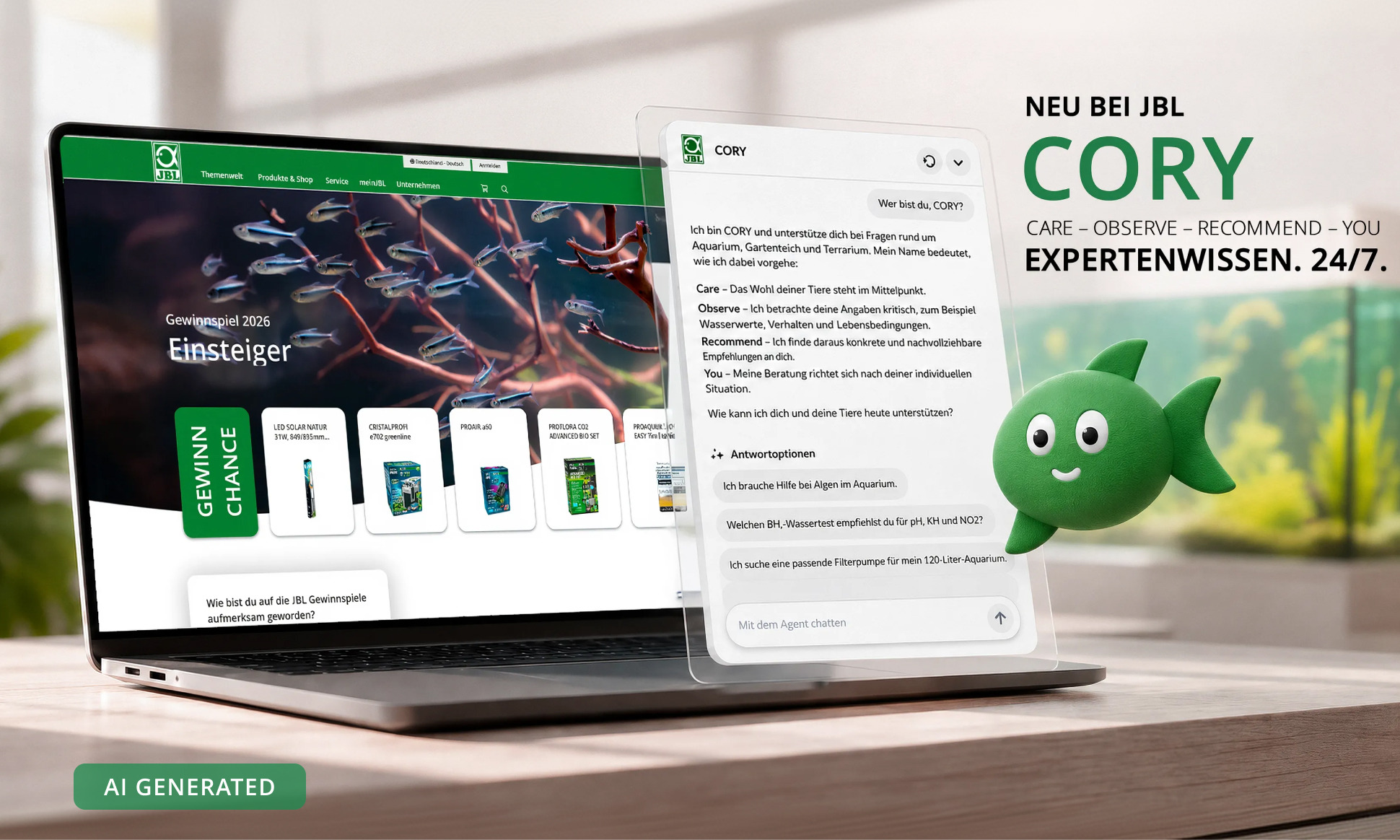
JBL introduces CORY: a smart chat agent for aquariums, terrariums and garden ponds

For the first time, CORY makes JBL’s decades of expert knowledge available round the clock. The intelligent chat agent supports pet owners with personalised recommendations for aquariums, terrariums and garden ponds – online, on the product itself and, in future, in specialist shops too.

Neuhofen – JBL is expanding its digital customer support with the addition of an intelligent chat agent: CORY. For the first time, this digital expert brings together JBL’s publicly available knowledge on aquariums, terrariums and garden ponds in a single, centralised, intelligent platform that is available round the clock.

The name CORY stands for the principles of Care, Observe, Recommend, You. Animal welfare is at the heart of every consultation. Unlike traditional chatbots, CORY does more than just answer individual questions. The chat agent analyses individual situations, explains technical concepts and develops specific, clear solutions.

CORY’s knowledge base comprises product information, user guides, specialist articles, advice guides, themed sections, FAQs, and content from JBL TV and JBL Wild Nature. This enables CORY to bring together knowledge from a wide variety of sources and utilise it to provide personalised advice.

Whether at home with your aquarium, if you have questions about your terrarium, or right by your garden pond: CORY supports users exactly when they need help. In future, the chat agent will be available not only online, but also directly with the product and on the shelves at selected specialist retailers.

Technologically, CORY is based on a modern multi-agent architecture from NEOCOM, whilst the structured knowledge base was developed in collaboration with October Labs GmbH. To this end, thousands of items of product, service, press and knowledge content from the JBL systems were processed and made suitable for use in modern AI applications.

© 25.08.2026 JBL GmbH & Co. KG

Information and consent to cookies & third-party content

We use technically necessary cookies/tools to offer, operate and secure this service. Furthermore ,with your express consent , we use cookies/tools for marketing, tracking, creating personalised content on third-party sites and for displaying third-party content on our website. You can revoke your consent at any time with effect for the future via the menu item ‘Cookie settings’.
By clicking on ‘Allow all’, you give us your express consent to the use of cookies/tools to improve the quality and performance of our service, for functional and personalised performance optimisation, to measure the effectiveness of our ads or campaigns, for personalised content for marketing purposes, including outside our website. This enables us to provide personalised online ads and extended analysis options about your user behaviour. This also includes accessing and storing data on your device. You can revoke your consent at any time with effect for the future via the menu item ‘Cookie settings’.
You can use the ‘Change settings’ button to grant and revoke individual consent to the cookies/tools and receive further information on the cookies/tools we use, their purposes and duration.
By clicking on ‘Only absolutely necessary’, only technically necessary cookies/tools are used.

Our data protection declaration tells you how we process personal data and what purposes we use the data processing for.

PUSH messages from JBL

What are PUSH messages? As part of the W3C standard, web notifications define an API for end-user notifications that are sent to the user's desktop and/or mobile devices via the browser. Notifications appear on the end devices as they are familiar to the end user from apps installed on the device (e.g. emails). Notifications appear on the end user’s device, just like an app (e.g. for emails) installed on the device.

A notification makes it possible to inform the user about an event outside the context of a website, such as a new blog post, a competition or a voucher.

These notifications enable a website operator to contact its users whenever they have a browser open - it doesn’t matter whether the user is currently visiting the website or not.

To be able to send web push notifications, all you need is a website with a web push code installed. This allows brands without apps to take advantage of many of the benefits of push notifications (personalised real-time communications at just the right moment).

Web notifications are part of the W3C standard and define an API for end user notifications. A notification makes it possible to inform the user about an event, such as a new blog post, outside the context of a website.

JBL GmbH & Co. KG provides this service free of charge, and it is easy to activate or deactivate.