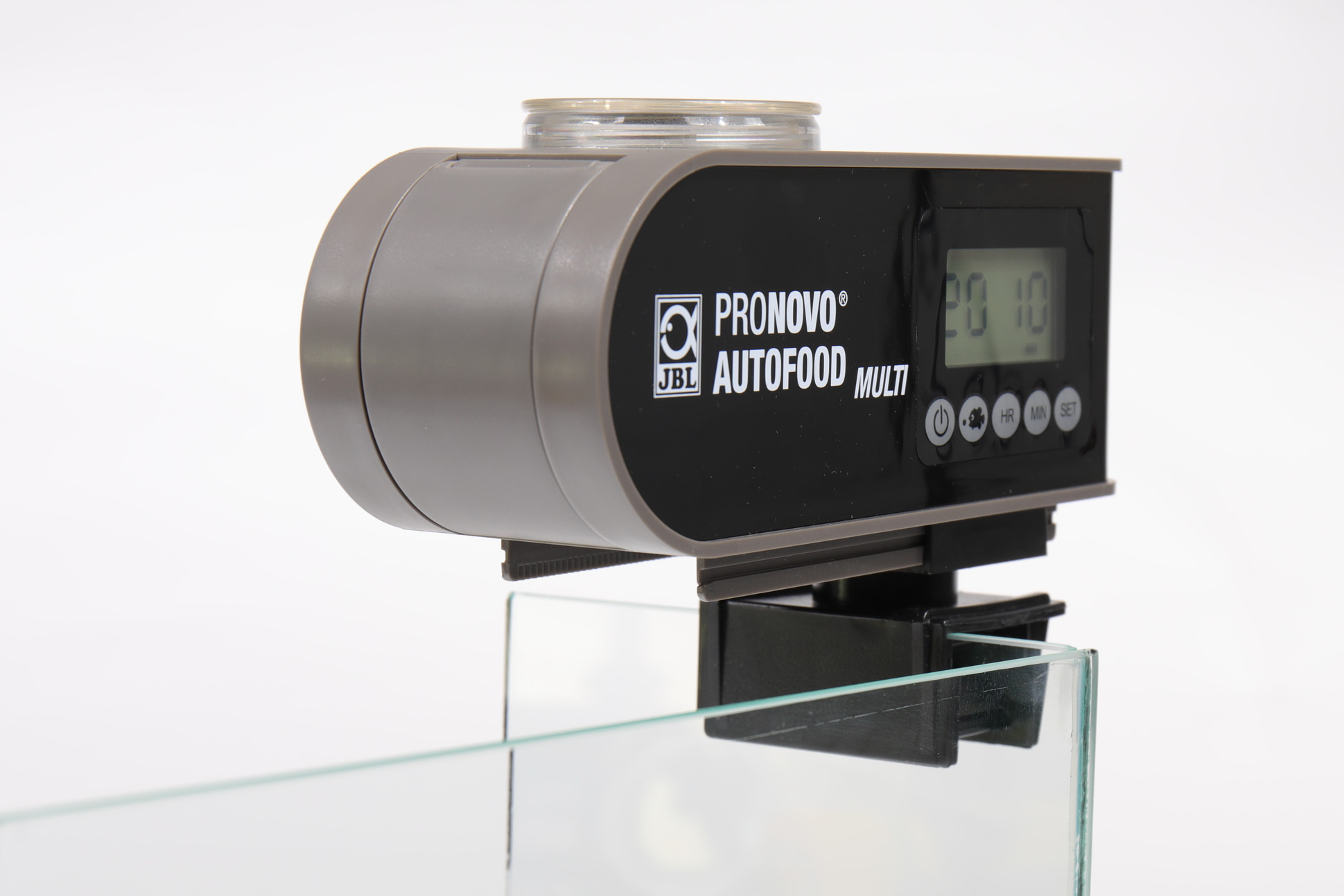
New JBL automatic feeder: Also suitable for flakes and super quiet

The next generation of aquarium automatic feeders is here: the JBL PRONOVO AUTOFOOD MULTI! The ‘MULTI’ in the name indicates that this completely redesigned and re-engineered automatic feeder can reliably dispense all types of pellets (up to 3 mm) and flake food up to six times a day. Six feedings a day may be necessary, particularly for small fish species and fry. The feed quantity can be adjusted in 10 stages and set individually for each feeding – and it can be programmed intuitively straight away. Ingenious: a flap only opens when feeding and closes again immediately afterwards. This prevents moist air from the opening rising into the feeder and causing the food to stick together! A warning light indicates when food levels are low, and two different mounting brackets ensure it fits any lid and any type of aquarium.

The JBL PRONOVO AUTOFOOD MULTI, finished in understated black, can be powered by three AA batteries or via a USB-C port. It holds approximately 125 ml of food and can be expanded to a capacity of 375 ml by screwing on a 250 ml can. That’s enough even for the longest holiday.

The new JBL automatic feeder is now available under order number 6063200.

© 26.02.2026 JBL GmbH & Co. KG

Information and consent to cookies & third-party content

We use technically necessary cookies/tools to offer, operate and secure this service. Furthermore ,with your express consent , we use cookies/tools for marketing, tracking, creating personalised content on third-party sites and for displaying third-party content on our website. You can revoke your consent at any time with effect for the future via the menu item ‘Cookie settings’.
By clicking on ‘Allow all’, you give us your express consent to the use of cookies/tools to improve the quality and performance of our service, for functional and personalised performance optimisation, to measure the effectiveness of our ads or campaigns, for personalised content for marketing purposes, including outside our website. This enables us to provide personalised online ads and extended analysis options about your user behaviour. This also includes accessing and storing data on your device. You can revoke your consent at any time with effect for the future via the menu item ‘Cookie settings’.
You can use the ‘Change settings’ button to grant and revoke individual consent to the cookies/tools and receive further information on the cookies/tools we use, their purposes and duration.
By clicking on ‘Only absolutely necessary’, only technically necessary cookies/tools are used.

W naszej strefie Polityka prywatności dowiedzą się Państwo, jak przetwarzamy dane osobowe i do jakich celów wykorzystujemy przetwarzanie danych.

Proszę wybrać swoje ustawienia Cookie

Wiadomości PUSH od JBL

Jako część standardu W3C, powiadomienia Web definiują API dla powiadomień użytkowników końcowych, które są wysyłane za pośrednictwem przeglądarki na pulpit urządzeń stacjonarnych i/lub urządzeń mobilnych użytkowników. Powiadomienia pojawiają się na urządzeniach końcowych tak, jak jest to znane użytkownikowi końcowemu z aplikacji zainstalowanych na urządzeniu (np. wiadomości e-mail).

Powiadomienia web push pojawiają się na pulpicie lub ekranie urządzenia mobilnego, kiedy użytkownik ma otwartą przeglądarkę - niezależnie od tego, czy użytkownik jest na tej stronie internetowej, czy nie.

Powiadomienia te umożliwiają operatorowi witryny kontaktowanie się z jego użytkownikami tak długo, jak długo mają oni otwartą przeglądarkę - niezależnie od tego, czy użytkownik aktualnie odwiedza stronę internetową, czy nie.

Aby móc wysyłać powiadomienia web push, wystarczy tylko strona internetowa z zainstalowanym kodem web push. Tym samym także marki bez aplikacji mogą korzystać z wielu zalet powiadomień push (spersonalizowana komunikacja w czasie rzeczywistym dokładnie w odpowiednim momencie.)

Powiadomienia internetowe są częścią standardu W3C i definiują API dla powiadomień użytkowników końcowych. Powiadomienie umożliwia poinformowanie użytkownika poza kontekstem strony internetowej o wydarzeniu, jak na przykład nowy wpis na blogu.

Usługa ta jest udostępniona bezpłatnie przez firmę JBL GmbH & Co. KG, i można ją równie łatwo aktywować jak i dezaktywować.