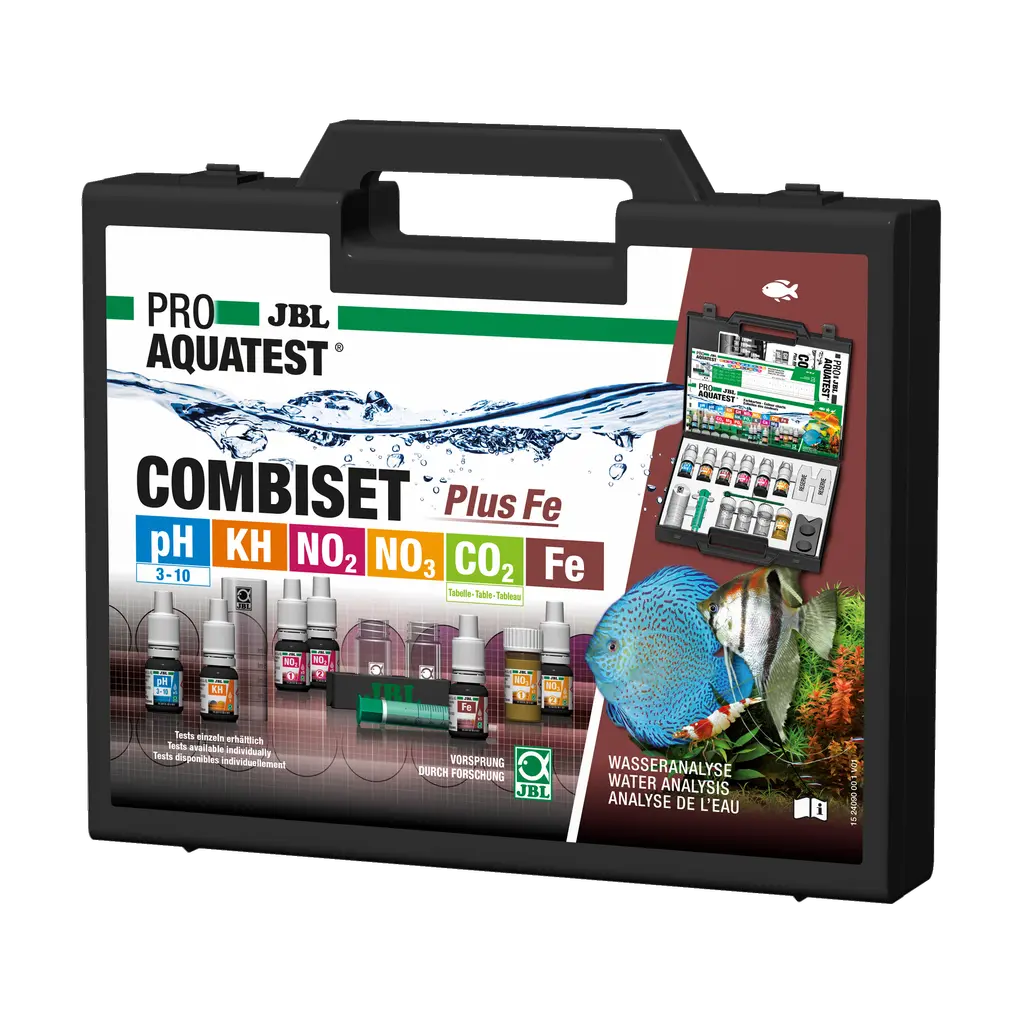
JBL PROAQUATEST COMBISET Plus Fe

Control sencillo y seguro de los valores del agua de los acuarios. Determinación de: valor pH, dureza carbonatada, hierro, nitrito, nitrato, CO2 (cálculo mediante tabla).
Artikel-Nr. 2409263

64.13 EUR

Preis inkl. 21 MwSt zzgl. Versand
Händlersuche Gefahrenhinweise

Produktmerkmale

  • Control sencillo y seguro de los parámetros del agua del acuario. Determina el pH, dureza de carbonatos, hierro, nitrito, nitrato, CO2 (cálculo mediante tabla)
  • Fácil de usar: echar agua del acuario con la jeringuilla en la cubeta, añadir el indicador y comparar el color con la escala de colores o, si es el test de KH, contar las gotas hasta que cambie de color
  • El sistema comparador tiene en cuenta la coloración propia del agua. La tabla indica la concentración de CO2 en función del valor del pH/KH
  • Frascos a prueba de niños, maletín de plástico resistente al agua, reactivos de relleno a la venta por separado
  • Suministro: 1 maletín de test para acuarios. 7 reactivos, 3 cubetas de cristal, jeringuilla, cuchara dosificadora, bloque comparador, cubeta de plástico, escalas de colores, hojas de protocolo, instrucciones de uso

Gefahrenhinweise

JBL pH 3-10 - Sicherheitsinformationen gemäß GHS

Signalwort: Atención

Gefahrensymbol

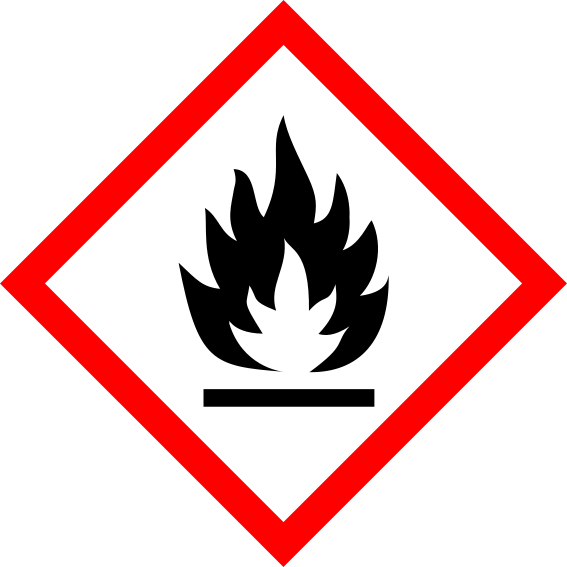
flammable irritant

Gefahrenhinweis

  • H319: Provoca irritación ocular grave.
  • H226: Líquidos y vapores inflamables.

Sicherheitshinweise

  • P101: Si se necesita consejo médico, tener a mano el envase o la etiqueta.
  • P102: Mantener fuera del alcance de los niños.

JBL NO3 2 - Sicherheitsinformationen gemäß GHS

Signalwort: Peligro

Gefahrensymbol

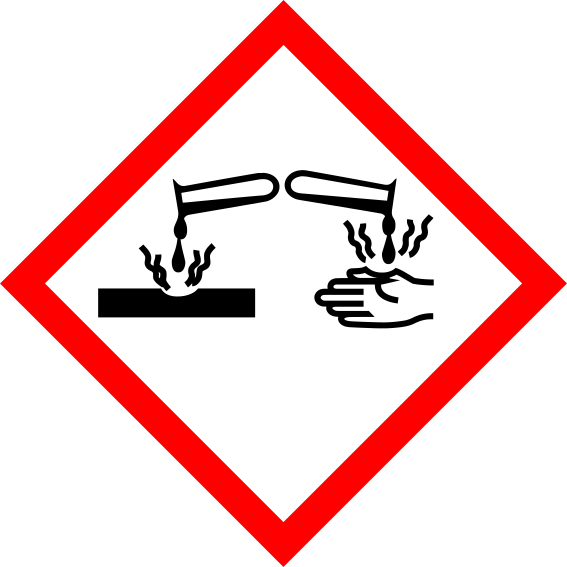
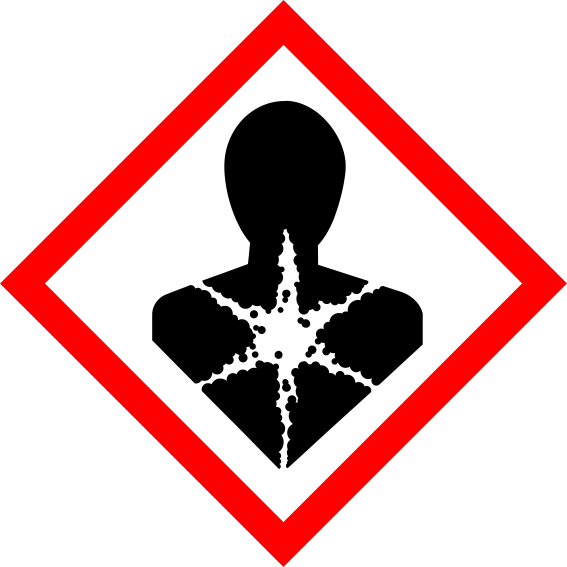
corrosive irritant health_hazard

Gefahrenhinweis

  • H318: Provoca lesiones oculares graves.
  • H314: Provoca quemaduras graves en la piel y lesiones oculares graves.
  • H341: Se sospecha que provoca defectos genéticos.
  • H317: Puede provocar una reacción alérgica en la piel.
  • H412: Nocivo para los organismos acuáticos, con efectos nocivos duraderos.

Sicherheitshinweise

  • P101: Si se necesita consejo médico, tener a mano el envase o la etiqueta.
  • P102: Mantener fuera del alcance de los niños.

Gefahrbestimmende Komponente

  • 7647-01-0/1: ácido clorhídrico
  • 541-69-5: m-fenilenodiamina, diclorhidrate

JBL NO3 1 - Sicherheitsinformationen gemäß GHS

Signalwort: Peligro

Gefahrensymbol

corrosive irritant environmental_hazard

Gefahrenhinweis

  • H318: Provoca lesiones oculares graves.
  • H314: Provoca quemaduras graves en la piel y lesiones oculares graves.
  • H317: Puede provocar una reacción alérgica en la piel.
  • H411: Tóxico para los organismos acuáticos, con efectos nocivos duraderos.

Sicherheitshinweise

  • P101: Si se necesita consejo médico, tener a mano el envase o la etiqueta.
  • P102: Mantener fuera del alcance de los niños.

Gefahrbestimmende Komponente

  • 87-69-4: ácido (+)-tartárico

JBL NO2 2 - Sicherheitsinformationen gemäß GHS

Signalwort: Atención

Gefahrensymbol

flammable irritant

Gefahrenhinweis

  • H319: Provoca irritación ocular grave.
  • H226: Líquidos y vapores inflamables.

Sicherheitshinweise

  • P101: Si se necesita consejo médico, tener a mano el envase o la etiqueta.
  • P102: Mantener fuera del alcance de los niños.

JBL NO2 1 - Sicherheitsinformationen gemäß GHS

Signalwort: Peligro

Gefahrensymbol

corrosive

Gefahrenhinweis

  • H318: Provoca lesiones oculares graves.
  • H314: Provoca quemaduras graves en la piel y lesiones oculares graves.

Sicherheitshinweise

  • P101: Si se necesita consejo médico, tener a mano el envase o la etiqueta.
  • P102: Mantener fuera del alcance de los niños.

Gefahrbestimmende Komponente

  • 64-19-7: ácido acético

JBL KH - Sicherheitsinformationen gemäß GHS

Signalwort: Peligro

Gefahrensymbol

flammable corrosive

Gefahrenhinweis

  • H226: Líquidos y vapores inflamables.
  • H318: Provoca lesiones oculares graves.
  • H314: Provoca quemaduras graves en la piel y lesiones oculares graves.

Sicherheitshinweise

  • P101: Si se necesita consejo médico, tener a mano el envase o la etiqueta.
  • P102: Mantener fuera del alcance de los niños.

JBL Fe - Sicherheitsinformationen gemäß GHS

Signalwort: Atención

Gefahrensymbol

irritant

Gefahrenhinweis

  • H319: Provoca irritación ocular grave.
  • H302: Nocivo en caso de ingestión.
  • H317: Puede provocar una reacción alérgica en la piel.

Sicherheitshinweise

  • P101: Si se necesita consejo médico, tener a mano el envase o la etiqueta.
  • P102: Mantener fuera del alcance de los niños.

Gefahrbestimmende Komponente

  • 5421-46-5: mercaptoacetato de amonio

Information and consent to cookies & third-party content

We use technically necessary cookies/tools to offer, operate and secure this service. Furthermore ,with your express consent , we use cookies/tools for marketing, tracking, creating personalised content on third-party sites and for displaying third-party content on our website. You can revoke your consent at any time with effect for the future via the menu item ‘Cookie settings’.
By clicking on ‘Allow all’, you give us your express consent to the use of cookies/tools to improve the quality and performance of our service, for functional and personalised performance optimisation, to measure the effectiveness of our ads or campaigns, for personalised content for marketing purposes, including outside our website. This enables us to provide personalised online ads and extended analysis options about your user behaviour. This also includes accessing and storing data on your device. You can revoke your consent at any time with effect for the future via the menu item ‘Cookie settings’.
You can use the ‘Change settings’ button to grant and revoke individual consent to the cookies/tools and receive further information on the cookies/tools we use, their purposes and duration.
By clicking on ‘Only absolutely necessary’, only technically necessary cookies/tools are used.

W naszej strefie Polityka prywatności dowiedzą się Państwo, jak przetwarzamy dane osobowe i do jakich celów wykorzystujemy przetwarzanie danych.
Proszę wybrać swoje ustawienia Cookie

Wiadomości PUSH od JBL

Jako część standardu W3C, powiadomienia Web definiują API dla powiadomień użytkowników końcowych, które są wysyłane za pośrednictwem przeglądarki na pulpit urządzeń stacjonarnych i/lub urządzeń mobilnych użytkowników. Powiadomienia pojawiają się na urządzeniach końcowych tak, jak jest to znane użytkownikowi końcowemu z aplikacji zainstalowanych na urządzeniu (np. wiadomości e-mail).

Powiadomienia web push pojawiają się na pulpicie lub ekranie urządzenia mobilnego, kiedy użytkownik ma otwartą przeglądarkę - niezależnie od tego, czy użytkownik jest na tej stronie internetowej, czy nie.

Powiadomienia te umożliwiają operatorowi witryny kontaktowanie się z jego użytkownikami tak długo, jak długo mają oni otwartą przeglądarkę - niezależnie od tego, czy użytkownik aktualnie odwiedza stronę internetową, czy nie.

Aby móc wysyłać powiadomienia web push, wystarczy tylko strona internetowa z zainstalowanym kodem web push. Tym samym także marki bez aplikacji mogą korzystać z wielu zalet powiadomień push (spersonalizowana komunikacja w czasie rzeczywistym dokładnie w odpowiednim momencie.)

Powiadomienia internetowe są częścią standardu W3C i definiują API dla powiadomień użytkowników końcowych. Powiadomienie umożliwia poinformowanie użytkownika poza kontekstem strony internetowej o wydarzeniu, jak na przykład nowy wpis na blogu.

Usługa ta jest udostępniona bezpłatnie przez firmę JBL GmbH & Co. KG, i można ją równie łatwo aktywować jak i dezaktywować.