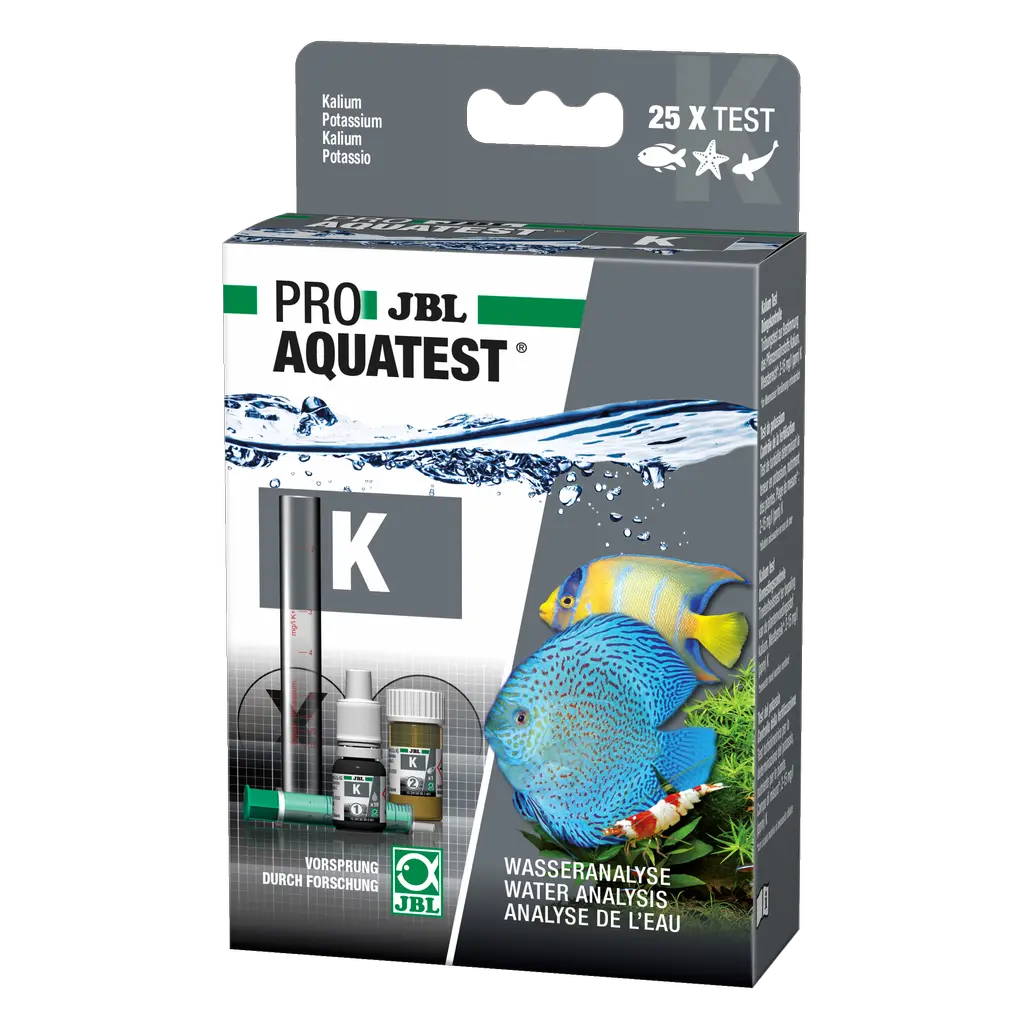
JBL PROAQUATEST K Kalium

Voor een perfecte groei van aquariumplanten: bepaling van de optimale kaliumwaarde voor bemestingscontrole voor zoetwateraquaria

28.8 EUR

Preis inkl. 21 MwSt zzgl. Versand
Händlersuche Gefahrenhinweise

Produktmerkmale

  • Voor een perfecte plantengroei: Bepaling van de optimale kaliumwaarde ten behoeve van de mestcontrole in zoetwateraquaria
  • Sneltest: Cuvet met testwater vullen, reagentia toevoegen, troebel testwater in de speciale glazen cuvet gieten tot het daaronder liggende kruis niet meer zichtbaar is, gevulde hoeveelheid aflezen. Deze waarde vormt het kaliumgehalte in mg/l
  • Vaak leidt een te gering kaliumgehalte tot een stagnerende plantengroei hoewel alle andere factoren, zoals CO2, ijzer en licht, beschikbaar zijn. Met meststoffen, zoals JBL Ferropol en JBL ProScape K macroelements, kunt u het kaliumgehalte verhogen
  • Op de JBL homepage in de themawereld Aquarium vindt u uitgebreide informatie met betrekking tot wateranalyses en probleemoplossingen
  • Inhoud: 1 Kalium testset voor ca. 25 metingen incl. reagentia, speciale glazen cuvet, spuit, doseerlepel en kleurenkaart. Navullende reagens afzonderlijk verkrijgbaar

Gefahrenhinweise

JBL K 1 - Sicherheitsinformationen gemäß GHS

Signalwort: Gevaar

Gefahrensymbol

corrosive

Gefahrenhinweis

  • H318: Veroorzaakt ernstig oogletsel.
  • H314: Veroorzaakt ernstige brandwonden en oogletsel.

Sicherheitshinweise

  • P101: Bij het inwinnen van medisch advies, de verpakking of het etiket ter beschikking houden.
  • P102: Buiten het bereik van kinderen houden.

Gefahrbestimmende Komponente

  • 1310-73-2: natriumhydroxide

JBL K 2 - Sicherheitsinformationen gemäß GHS

Signalwort: Gevaar

Gefahrensymbol

corrosive

Gefahrenhinweis

  • H318: Veroorzaakt ernstig oogletsel.
  • H314: Veroorzaakt ernstige brandwonden en oogletsel.

Sicherheitshinweise

  • P101: Bij het inwinnen van medisch advies, de verpakking of het etiket ter beschikking houden.
  • P102: Buiten het bereik van kinderen houden.

Information and consent to cookies & third-party content

We use technically necessary cookies/tools to offer, operate and secure this service. Furthermore ,with your express consent , we use cookies/tools for marketing, tracking, creating personalised content on third-party sites and for displaying third-party content on our website. You can revoke your consent at any time with effect for the future via the menu item ‘Cookie settings’.
By clicking on ‘Allow all’, you give us your express consent to the use of cookies/tools to improve the quality and performance of our service, for functional and personalised performance optimisation, to measure the effectiveness of our ads or campaigns, for personalised content for marketing purposes, including outside our website. This enables us to provide personalised online ads and extended analysis options about your user behaviour. This also includes accessing and storing data on your device. You can revoke your consent at any time with effect for the future via the menu item ‘Cookie settings’.
You can use the ‘Change settings’ button to grant and revoke individual consent to the cookies/tools and receive further information on the cookies/tools we use, their purposes and duration.
By clicking on ‘Only absolutely necessary’, only technically necessary cookies/tools are used.

W naszej strefie Polityka prywatności dowiedzą się Państwo, jak przetwarzamy dane osobowe i do jakich celów wykorzystujemy przetwarzanie danych.

Proszę wybrać swoje ustawienia Cookie

Wiadomości PUSH od JBL

Jako część standardu W3C, powiadomienia Web definiują API dla powiadomień użytkowników końcowych, które są wysyłane za pośrednictwem przeglądarki na pulpit urządzeń stacjonarnych i/lub urządzeń mobilnych użytkowników. Powiadomienia pojawiają się na urządzeniach końcowych tak, jak jest to znane użytkownikowi końcowemu z aplikacji zainstalowanych na urządzeniu (np. wiadomości e-mail).

Powiadomienia web push pojawiają się na pulpicie lub ekranie urządzenia mobilnego, kiedy użytkownik ma otwartą przeglądarkę - niezależnie od tego, czy użytkownik jest na tej stronie internetowej, czy nie.

Powiadomienia te umożliwiają operatorowi witryny kontaktowanie się z jego użytkownikami tak długo, jak długo mają oni otwartą przeglądarkę - niezależnie od tego, czy użytkownik aktualnie odwiedza stronę internetową, czy nie.

Aby móc wysyłać powiadomienia web push, wystarczy tylko strona internetowa z zainstalowanym kodem web push. Tym samym także marki bez aplikacji mogą korzystać z wielu zalet powiadomień push (spersonalizowana komunikacja w czasie rzeczywistym dokładnie w odpowiednim momencie.)

Powiadomienia internetowe są częścią standardu W3C i definiują API dla powiadomień użytkowników końcowych. Powiadomienie umożliwia poinformowanie użytkownika poza kontekstem strony internetowej o wydarzeniu, jak na przykład nowy wpis na blogu.

Usługa ta jest udostępniona bezpłatnie przez firmę JBL GmbH & Co. KG, i można ją równie łatwo aktywować jak i dezaktywować.